
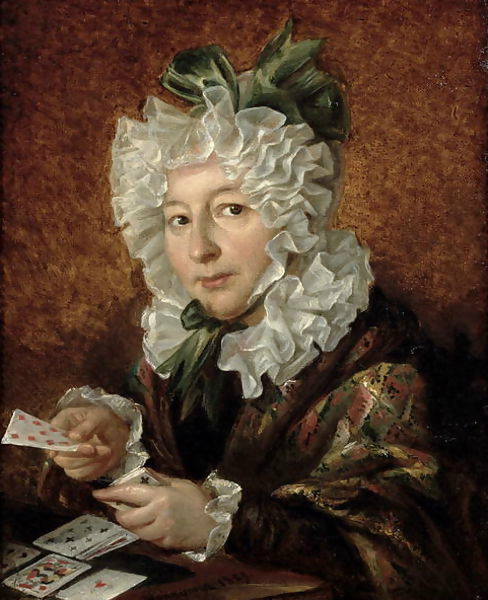
Walenty Wańkowicz’s Woman Playing Solitaire, dated 1829, is an oil-on-canvas portrait whose image is considerably easier to find than the painting itself. It has been reproduced in publications and online references to the artist, yet basic information about the physical object remains incomplete. Bridgeman Images records the work as oil on canvas under reference CIE116615, while its dimensions and present location remain unconfirmed in the sources currently available. Its recent provenance leads to the collection associated with Professor Andrzej Ciechanowiecki before becoming uncertain after 2016.
The work is important for reasons that go beyond the unresolved provenance. Wańkowicz was one of the significant painters formed within the artistic environment of Vilnius University. He studied under Jan Rustem and belonged to the generation associated with the Vilnius School of Art, whose artists played a central role in the development of nineteenth-century painting in Lithuania and the former lands of the Grand Duchy. His works are represented in major museum collections in Lithuania and Poland, while his portrait of Adam Mickiewicz on the rock of Ayu-Dag became one of the best-known images of Romanticism. Woman Playing Solitaire is therefore a recognised work by an artist of considerable importance to Lithuanian art history, not an anonymous portrait whose attribution has only recently been proposed.
Wańkowicz and the Vilnius School
Wańkowicz studied at Vilnius University between 1818 and 1824, with Jan Rustem among the most important figures in his artistic formation. Rustem had established a strong tradition of portraiture in Vilnius in which likeness and social position were combined with close attention to character. Wańkowicz developed within that environment before continuing his education at the Imperial Academy of Arts in St Petersburg from 1825. By 1829, when Woman Playing Solitaire was painted, he had completed an important stage of his academic training and had already begun to establish himself as a portraitist.
His place in Lithuanian art history should be understood through that Vilnius connection. Like many artists from the former Grand Duchy of Lithuania, Wańkowicz does not fit neatly within present-day national boundaries: he was born in the Minsk Governorate, trained in Vilnius and St Petersburg, worked within the cultural networks of the former Polish-Lithuanian Commonwealth and died in Paris. Lithuanian, Polish and Belarusian scholarship therefore approach his legacy from different perspectives, but his education under Rustem and his place within the Vilnius School are firmly established. His works form part of the nineteenth-century narrative presented by Lithuanian museums, and the Vilnius period is fundamental to understanding his development as an artist.
An unusual portrait
The painting differs noticeably from the kind of portraiture for which Wańkowicz is best known, particularly his celebrated image of Adam Mickiewicz. There is no Romantic landscape or attempt to construct the sitter as a public figure. Instead, a woman is shown indoors at a table, occupied with a game of patience. Her clothing is carefully described, particularly the large white bonnet surrounding her face, but the composition remains restrained. The cards introduce an element of everyday activity without turning the picture into a genre scene, and the result is a portrait that feels more private than ceremonial.
The woman in the portrait
The sitter may be identifiable. Bridgeman Images records the work under reference CIE116615 as Portrait of a Woman Playing Patience, 1829, oil on canvas, and describes the sitter as the “mother of Madame Eveline Hanska.” If that identification is correct, it points to Justyna Rdułtowska-Rzewuska, wife of Adam Wawrzyniec Rzewuski. An independent biographical entry for their daughter Karolina Sobańska in the Polish Biographical Dictionary identifies Karolina as a daughter of Adam Wawrzyniec Rzewuski and Justyna Rdułtowska, and as the sister of Ewa Hańska-Balzakowa and the writer Henryk Rzewuski. The underlying collection document from which Bridgeman derived the sitter description has not yet been located, so Justyna Rdułtowska-Rzewuska should at present be treated as a strong identification rather than as conclusively proven.
The family connection gives the portrait a wider historical context. Ewelina Hańska later became closely associated with Honoré de Balzac. According to the Maison de Balzac, she wrote to him anonymously from Odessa in March 1832 under the signature L’Étrangère, beginning a correspondence that continued for many years. They eventually married on 14 March 1850. The portrait predates that correspondence by three years, so if the Bridgeman identification is correct, Wańkowicz painted the mother of Balzac’s future wife before Balzac and Ewelina had begun their relationship.
Justyna’s other daughter, Karolina Sobańska, provides a second connection to the literary world around Wańkowicz. The Polish Biographical Dictionary describes Karolina as a friend of Adam Mickiewicz. This is particularly relevant because Mickiewicz was the sitter in Wańkowicz’s most celebrated portrait. The identification therefore places Woman Playing Solitaire within a family linked to both Balzac and Mickiewicz, while also raising a further provenance question: whether the sitter’s identity was preserved through family ownership and later entered the Ciechanowiecki documentation, or whether it was proposed at a later stage.
Why the painting is being sought
The Missing Canvas is actively seeking Woman Playing Solitaire because it combines artistic importance with an unresolved modern provenance. Much of Wańkowicz’s established oeuvre is now held in institutional collections, while other works have remained in families and private collections. Locating this painting would make it possible to document its present condition, dimensions, medium, inscriptions, labels and reverse, while its ownership history could reveal information that has never entered the published literature.
The Ciechanowiecki connection
The most important recent point in the painting’s history is its connection with Professor Andrzej Ciechanowiecki, the art historian, collector and dealer whose career was closely associated with the study and collecting of art from the former Polish-Lithuanian Commonwealth. His collection was formed with substantial knowledge of the historical networks from which many of the works had emerged, so the presence of a Wańkowicz within that context is significant in itself.
The Missing Canvas contacted representatives connected with Professor Ciechanowiecki’s estate to determine whether Woman Playing Solitaire remained there and whether a possible acquisition could be discussed. The response provided one clear point in the modern provenance: the painting had not formed part of Professor Ciechanowiecki’s estate since 2016, and the estate was therefore unable to assist with an enquiry concerning its possible acquisition.
That wording needs to be preserved accurately. It establishes that the painting was no longer part of the estate after 2016, but it does not identify when or how it left, nor does it identify the subsequent owner. No public auction record has yet been located that explains the transfer, and there is no basis at present for stating that the painting was sold publicly in 2016. A private sale, gift or another form of transfer remains possible.
Reconstructing the recent provenance
The research question is therefore unusually specific. Rather than asking whether a work mentioned in a nineteenth-century inventory survived at all, the task is to determine what happened to a known painting within roughly the last decade. A private transaction may have produced no public catalogue or sale announcement, but it would still have involved people and documentation. Correspondence, invoices, insurance records, conservation photographs or an adviser’s files could contain the information needed to establish the next stage of ownership.
The absence of an auction record is not in itself unusual. Significant paintings often move between private collections without public exposure, and once a work enters another private collection, published information can remain unchanged for many years. Reproductions of Woman Playing Solitaire continue to circulate, but repeated use of the same image can create the impression that the object is well documented when the underlying catalogue information is in fact limited.
The earlier provenance may be equally important
Finding the present owner would answer the immediate question, but the earlier provenance may be just as valuable. Wańkowicz worked within an interconnected society of landowners, intellectuals and artists associated with Vilnius, Minsk and St Petersburg, and many of his portraits were private commissions that remained within families before entering institutional or commercial collections. If Woman Playing Solitaire descended for a substantial period within the Rzewuski family or another circle connected with the sitter, an earlier inventory or ownership record could help confirm, refine or challenge the Bridgeman identification of the woman as Ewelina Hańska’s mother.
The physical painting could also supply evidence that reproductions cannot. Photographs of the reverse and frame would be particularly useful, since old inventory numbers, exhibition labels, collection stamps or handwritten inscriptions often preserve information omitted from later catalogues. Even a framemaker’s label or a customs mark can establish where a work was at a particular moment. Until the painting is located and examined, these possibilities remain unavailable.
Why the painting matters in Lithuania
Wańkowicz belongs to a generation educated at Vilnius University before its closure in 1832, when the city had developed a substantial academic artistic tradition. Alongside artists such as Kanuty Rusiecki and Wincenty Dmochowski, he represents the network formed around Rustem and the Vilnius School, a network whose members later worked across a much wider European geography. Concentrating only on Wańkowicz’s famous Mickiewicz portrait can obscure the broader body of portraiture through which he recorded the society around him.
Woman Playing Solitaire is valuable in this respect because it presents a different side of his practice: less public, less literary and closer to the domestic environment in which much nineteenth-century portraiture was originally commissioned and preserved. For Lithuanian collections, works of this kind also have a wider historical relevance. A significant proportion of art associated with nineteenth-century Lithuania was dispersed through inheritance, migration, political upheaval and the international art market. Researching those works, documenting their provenance and, where circumstances allow, returning important examples to Lithuanian collections contributes to a fuller understanding of a history that became geographically fragmented over almost two centuries.
The search for Woman Playing Solitaire
The Missing Canvas is actively seeking the present location of Walenty Wańkowicz’s Woman Playing Solitaire and further information concerning both its earlier provenance and its ownership after its connection with Professor Andrzej Ciechanowiecki’s collection ended. We would welcome confidential contact from the present owner, former owners, descendants, collectors, advisers, dealers or researchers who may have information about the work. Photographs of the painting, particularly the reverse and frame, as well as old collection inventories, exhibition records, correspondence or documents relating to its transfer would be especially useful.
The interest is both scholarly and acquisitional. The Missing Canvas would like to document the painting properly and reconstruct its provenance, but there is also a serious interest in acquiring the work for a private Lithuanian collection should its present owner be willing to consider a sale. Any enquiry concerning ownership or a possible acquisition would be treated confidentially.
Information sought
Do you know where this painting is?
The Missing Canvas is actively tracing Walenty Wańkowicz’s Woman Playing Solitaire, 1829. If you own the work, represent the owner or have documentary information concerning its provenance after 2016, please contact Dominykas Šaudys, Art Dealer & Collector. All enquiries are handled confidentially.
Research references
- The Missing Canvas — Walenty Wańkowicz, Woman Playing Solitaire, 1829.
- Visuotinė lietuvių enciklopedija — Valentinas Vankavičius.
- Bridgeman Images — Walenty Wańkowicz, Portrait of a Woman Playing Patience, 1829, ref. CIE116615.
- Polski Słownik Biograficzny — Karolina Sobańska.
- Maison de Balzac / Paris Musées — Ewelina Hańska.
- Private correspondence with representatives connected with Professor Andrzej Ciechanowiecki’s estate, 2026.
Comments & research notes
Share a provenance lead
If you know the present owner, a former collection, sale, adviser or document connected with this painting, you are welcome to contribute a research note.
Loading comments…