
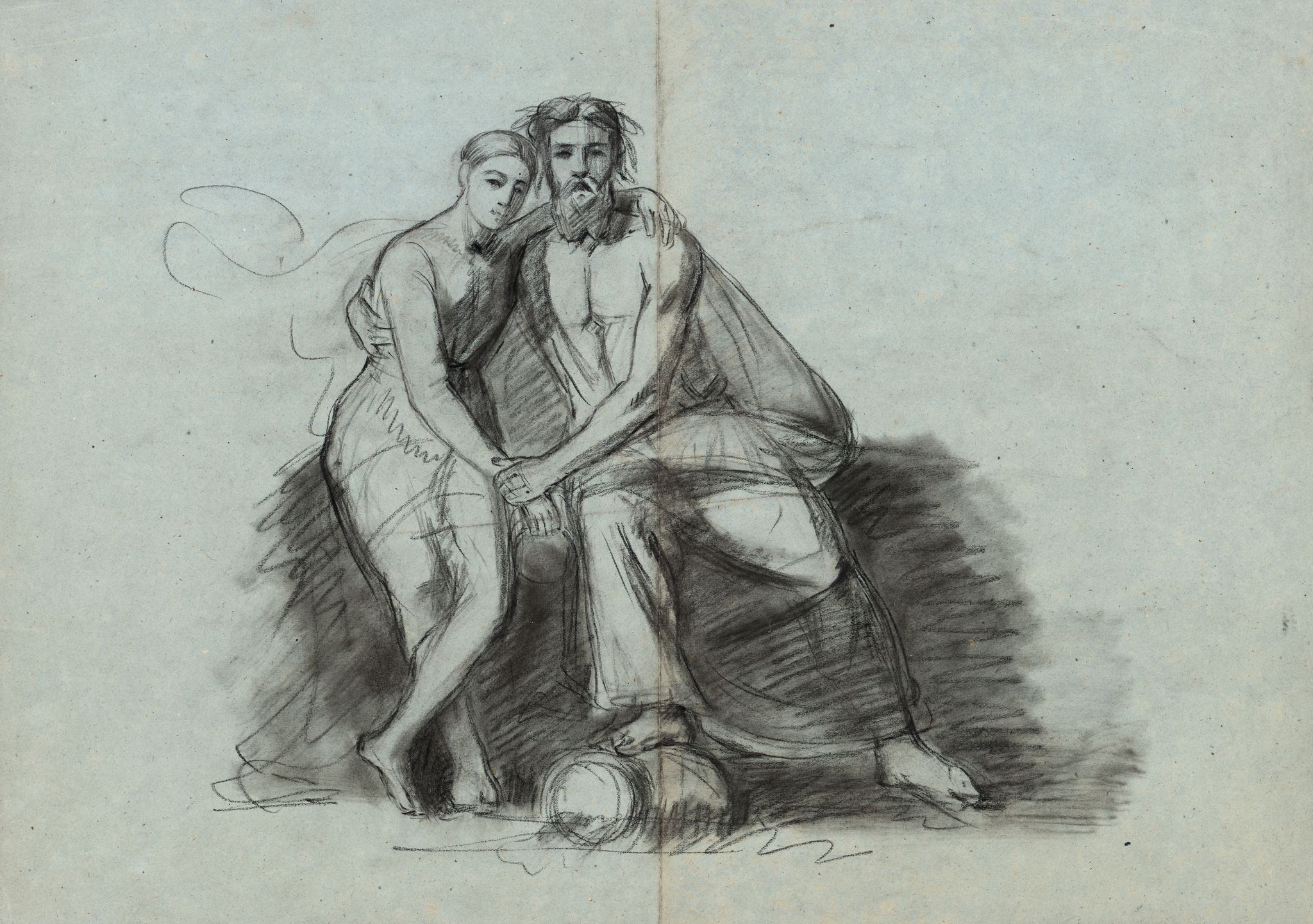
In 1853, Bolesław Rusiecki created one of the most ambitious compositions of his career: Neris and Nemunas, known in contemporary Polish sources as Wilia i Niemen or Połączenie Willi z Niemnem. The large allegorical painting was presented at the Imperial Academy of Arts in St Petersburg while Rusiecki was seeking academic recognition. The finished canvas has since disappeared from the public record.
The painting
The composition personified Lithuania’s two great rivers. A surviving preparatory drawing shows the basic idea: two figures brought together in a symbolic embrace. Museum research has also connected the commission with the Lithuanian collector Ludwik Petkiewicz, who reportedly wanted the figures to recall Jogaila and Jadwiga. That would have made the meeting of the rivers an allusion not only to landscape, but also to the historical union of Lithuania and Poland.
Rusiecki eventually moved away from the explicit likenesses requested by the patron, yet the political association appears to have remained. In 1853 the Academy granted him the status of a candidate to academicians rather than the full title he had hoped to secure. The painting nevertheless occupied an important place in his early career.
Today the finished composition is regarded as lost. Rusiecki’s 2024 retrospective at the Vilnius Picture Gallery drew attention to the fragmentary nature of his oeuvre and to the preparatory material that sometimes provides the only surviving evidence for large compositions that are missing or still unidentified.
What happened after St Petersburg?
This is where the history becomes uncertain. One provenance lead points toward Abromiškės Manor, a historic estate east of Vilnius that belonged to the Broel-Plater family. The connection between the lost painting and Abromiškės is a research lead rather than a fully documented chain of ownership, but it is important because the manor is known to have contained paintings, a large library, family archives and collections of decorative art.
After Wilhelm Broel-Plater’s death, the estate passed to his widow Felicja Soltan Broel-Plater and their daughters, including Idalia Broel-Plater, later Ilińska-Kaszowska. If the Rusiecki was still at Abromiškės during this period, its later history may have followed either the family collection or the next owner of the manor.
The Broel-Plater route
One possibility is that Neris and Nemunas was considered part of the movable family collection and was removed before the manor changed hands. In that case, the trail may continue through Felicja, Idalia or another member of the Broel-Plater family.
A large historical painting could have passed by inheritance, marriage or division of family property without ever appearing at auction. It could also have travelled abroad with descendants, entered another family collection, or been sold privately. If that happened, the original title may have been lost along the way.
For this reason, family inventories, correspondence, photographs of Abromiškės interiors and papers relating to the division or removal of the estate’s contents may be more useful than auction records alone.
The Mykolas Žilinskas possibility
The other major route leads through Mykolas Žilinskas (1904–1992), who acquired Abromiškės in the 1930s. Sources differ on whether the purchase should be dated to 1933 or 1937, but they agree that Žilinskas became the manor’s last important private owner before the Soviet period.
Žilinskas was not simply a purchaser of an old estate. He was a Lithuanian lawyer, senior civil servant, businessman, collector and later one of the country’s most significant art patrons. He studied humanities and law in Kaunas, worked in the Ministry of the Interior and became head of the Cabinet Chancellery. Having become financially successful, he acquired property in Kaunas and Abromiškės and had already begun collecting works of art with the intention of decorating the manor.
That makes the sale of Abromiškės especially important. If Rusiecki’s painting remained in the house, Žilinskas may have acquired it together with the manor or its contents.
A local history of Abromiškės records that when Žilinskas emigrated at the beginning of the war, he took the manor’s painting collection with him. There is not yet an itemised list proving that Neris and Nemunas was among those works, but the statement is significant enough to make his later movements relevant to the search.
Žilinskas left Lithuania in 1940. He lived in France, Berlin and Denmark, later studied again in Paris, and eventually settled in West Berlin. He continued collecting art abroad and later donated a substantial number of works to Lithuania; the Mykolas Žilinskas Art Gallery in Kaunas bears his name.
If the painting travelled with Žilinskas
If the Rusiecki was among the paintings removed from Abromiškės, its provenance may continue outside Lithuania. A large canvas could have been rolled for transport, stored for years, reframed, sold privately or transferred to another collector in France, Germany or Denmark.
It is also possible that Žilinskas later sold the painting. He was an experienced businessman as well as a collector, and his life abroad involved repeated moves and changes of circumstances. There is currently no evidence of a specific sale of Neris and Nemunas, but a private transaction would not necessarily have left a public auction record.
Other possibilities
The Abromiškės hypothesis is not the only explanation. The painting may have left the manor long before Žilinskas acquired it. It may have remained with the Broel-Platers, been sold privately during the interwar years, or disappeared during wartime displacement.
There is also the possibility that the painting survives today but has not been recognised. Rusiecki remains far less internationally familiar than his father Kanuty. A large unsigned, misattributed or generically titled allegorical painting could conceivably remain in a private collection, historic residence or museum storage without being connected to the lost 1853 composition.
Why Abromiškės matters
The Abromiškės lead gives the search a concrete place and two identifiable provenance routes: the Broel-Plater family and Mykolas Žilinskas. The next step is documentary rather than speculative: to locate inventories, interior photographs, correspondence, transport records and lists of paintings associated with the manor before and after its sale.
Several questions remain open. Was Rusiecki’s painting ever recorded in an Abromiškės inventory? Did it appear in photographs of the manor? Were paintings listed separately when the estate was sold? What works did Žilinskas take abroad in 1940? Did any of them later enter the art market or his eventual donations to Lithuania?
Do you know anything about this painting?
The Missing Canvas is actively seeking Bolesław Rusiecki’s original 1853 painting Neris and Nemunas. We would be grateful to hear from anyone with information relating to Abromiškės Manor, the Broel-Plater family, Mykolas Žilinskas, or the later history of the painting.
Old photographs, estate inventories, family correspondence, transport records, collection lists, auction catalogues, inscriptions, labels or recollections from descendants may all be important.
If the original painting survives in lawful private ownership, we would be interested in discussing its acquisition. Information is equally valuable if the work is not for sale, and all enquiries can be treated confidentially. Contact The Missing Canvas →
A note on provenance. The connection between Neris and Nemunas and Abromiškės is presented here as a research lead. The ownership sequence described above should not be read as a proven object-by-object provenance until supporting inventories or other primary documents are located.
Sources and further reading: Lithuanian National Museum of Art — Bolesław Rusiecki retrospective; LRT — research on Neris and Nemunas; Visuotinė lietuvių enciklopedija — Mykolas Žilinskas; Elektrėnų Kronika — Abromiškės Manor.
Comments & research notes
Share what you know
If you have information about the painting, Abromiškės Manor, the Broel-Plater family or Mykolas Žilinskas, you are welcome to leave a research note.
Loading comments…