
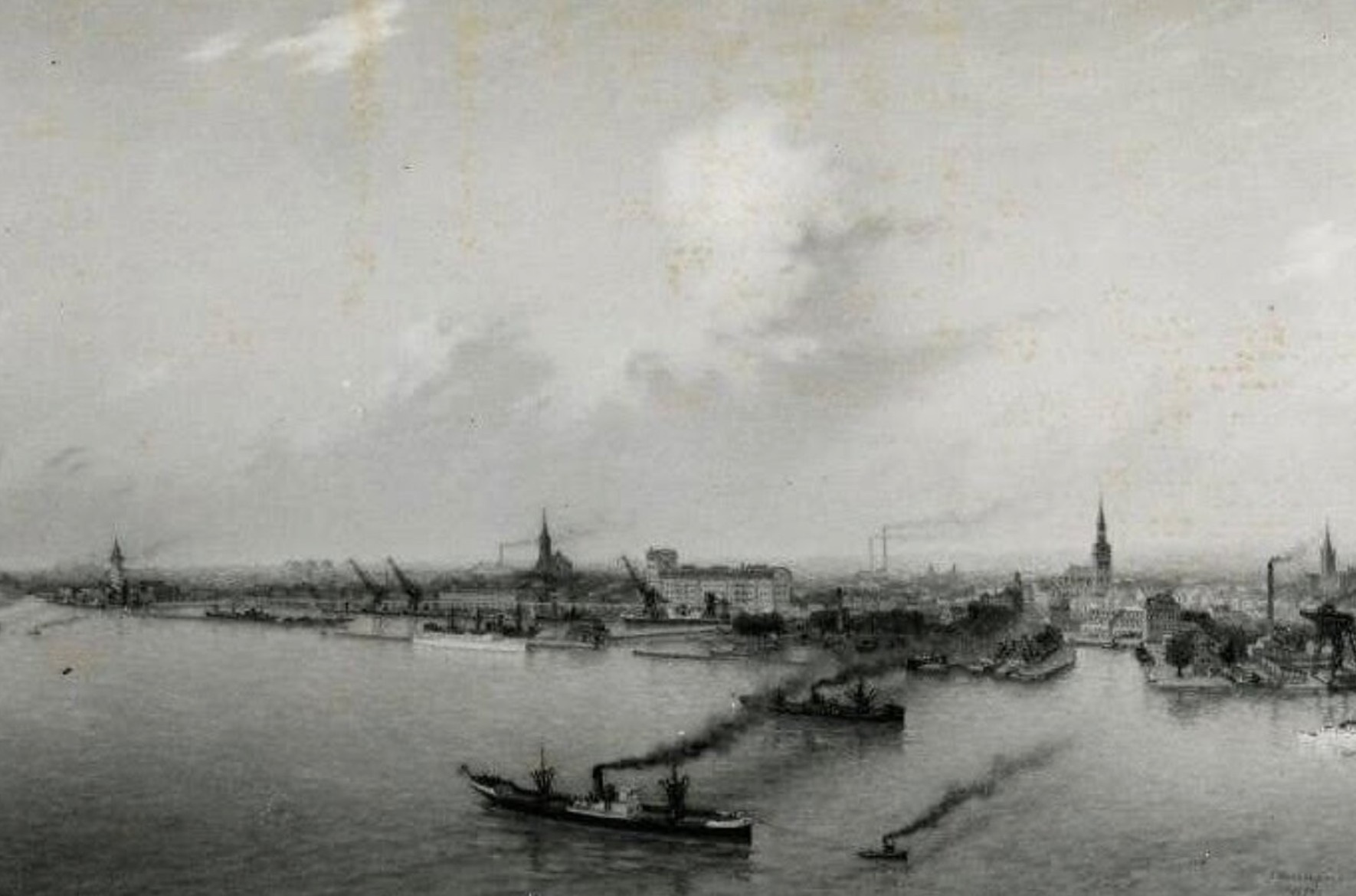
Some missing paintings disappear quietly into private collections. Lietuvos vartai į jūras is different. Its disappearance is tied directly to the history of occupied Lithuania, and the surviving evidence tells us exactly where the painting stood before it was taken.
In 1938, the Klaipėda Chamber of Industry and Commerce decided to give a painting to the newly built Chamber of Commerce, Industry and Crafts in Kaunas. The subject was deliberately symbolic. Klaipėda and its harbour were Lithuania’s physical connection to the Baltic Sea and to international trade, and the gift was intended to make that importance visible inside one of the new state’s most representative buildings.
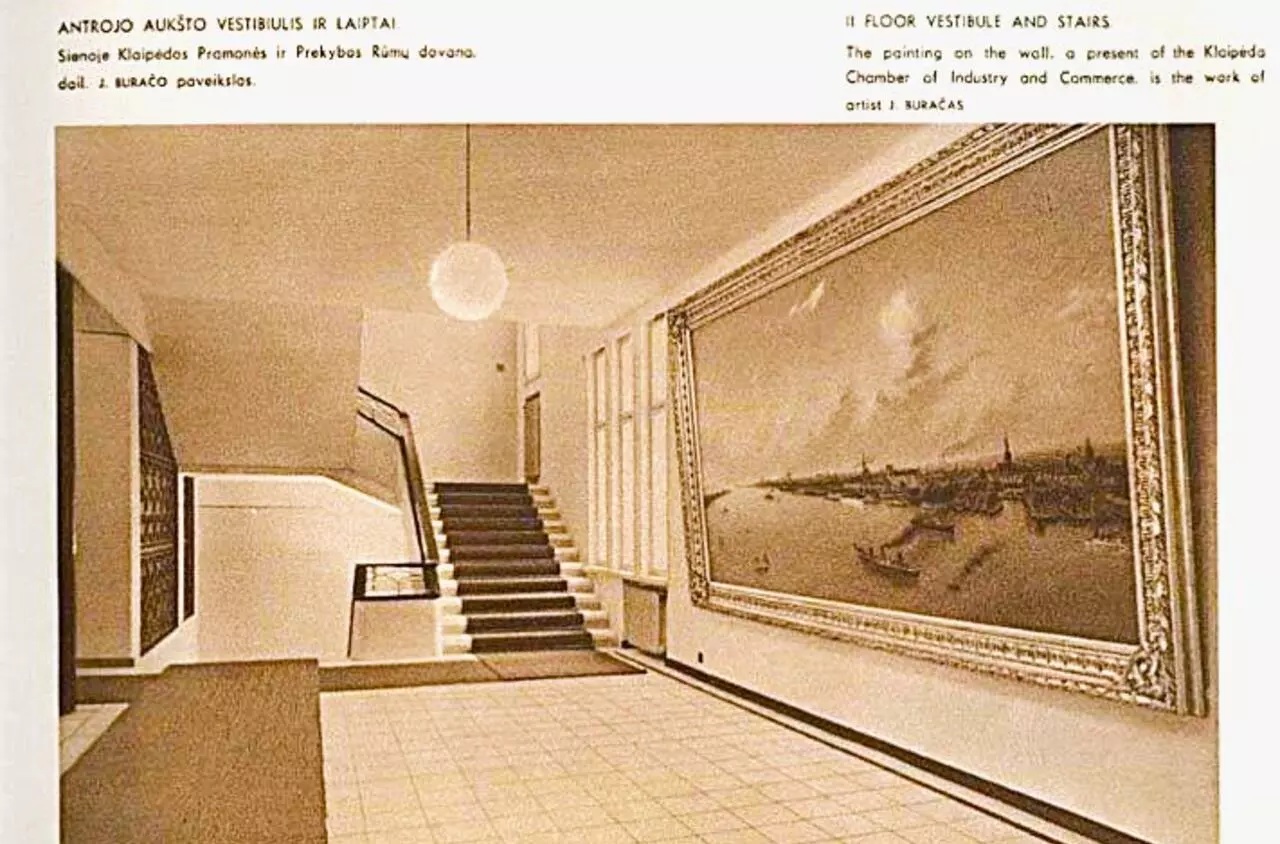
Jonas Buračas (1898–1977) won the public competition. The result was unusually large for the artist: approximately two metres high and four metres wide. He painted the harbour and city from the Smiltynė side. Surviving descriptions identify a number of landmarks that later disappeared or changed beyond recognition — among them the tower of St John’s Church, the Reformed and St James churches, harbour installations, warehouses and industrial buildings. The painting was already photographed and published in the Klaipėda newspaper Vakarai in September 1938.
When the Kaunas Chamber building formally opened in February 1939, the painting by Buračas occupied the second-floor vestibule. A period photograph shows just how dominant it was in the architecture. It was not a small decorative picture added later; the enormous canvas formed part of the visual identity of the interior.
The political situation changed almost immediately. After the Soviet occupation of Lithuania in 1940, the building was nationalised and the Chamber was dissolved. Historical accounts state that the painting was assigned to the M. K. Čiurlionis Art Gallery, but for reasons that remain unclear it was not physically transferred there before the Nazi occupation began.
Under the German occupation, the former Chamber building became the headquarters of General Commissioner Adrian von Renteln. In July 1944, as the front approached Kaunas, the painting disappeared. In a 2026 LRT interview, the artist’s son Antanas Buračas recalled a handwritten account found in his father’s archive: according to that account, Jonas Buračas himself saw the painting being taken from its frame, rolled and loaded onto a truck.
From that point the documentary trail becomes uncertain, but there is one persistent lead. The 1981 catalogue Jono Buračo tapyba referred to the possibility that the painting had reached a museum in Frankfurt am Main. Antanas Buračas has also said that the Lithuanian émigré journalist and researcher Bronius Kviklys told him in Chicago that he had seen the painting in Frankfurt after the war. Kviklys reportedly mentioned the museum, but the name was not remembered.
That does not prove that the painting is still in Frankfurt, or even that the sighting was correctly identified. It does, however, make institutional collections and post-war museum records especially important. A canvas approximately four metres wide, even if removed from its stretcher and stored rolled, is a substantial object. It may have entered a museum depot under an incomplete title, a German description, an uncertain attribution, or simply as displaced property.
There is now renewed institutional attention in Lithuania. A Lithuanian government report concerning work carried out in 2025 identified the need to contact the German Lost Art Foundation so that information about the Nazi-looted painting could be published in the Lost Art Database. In July 2026, a representative of the Ministry of Culture confirmed to LRT that the disappearance of Lietuvos vartai į jūras had been registered in the Cultural Heritage Department’s database of missing cultural valuables. Antanas Buračas has expressed the view that ownership rights passed to the Lithuanian state; the precise legal and restitution questions ultimately belong to the competent authorities and documentary record.
For The Missing Canvas, the immediate question is simpler: where is the painting now?
We would particularly like to hear from museum staff, archivists, provenance researchers and families who may remember a very large Klaipėda harbour panorama in Germany after the war. A museum name, an old inventory card, a photograph of a storage room, a transport list, an exhibition catalogue or even a well-founded recollection could be enough to move the search forward. The work may still be in an institution. It may have moved again decades ago. At present, nobody can say with certainty.
This is not a normal acquisition story. The painting was created for a Lithuanian public institution, was caught in successive occupations, and was removed from Lithuania during the final phase of Nazi rule. Finding it would mean recovering not only an important work by Jonas Buračas, but a physical piece of the history of interwar Klaipėda and Kaunas.
Comments & research notes
Have you seen this painting?
If you recognise the work from a museum, archive, storage facility, photograph or family memory, you may leave information anonymously.
Loading comments…
Public comments are contributions from visitors and do not represent The Missing Canvas. Inaccurate, abusive or inappropriate comments may be removed.