
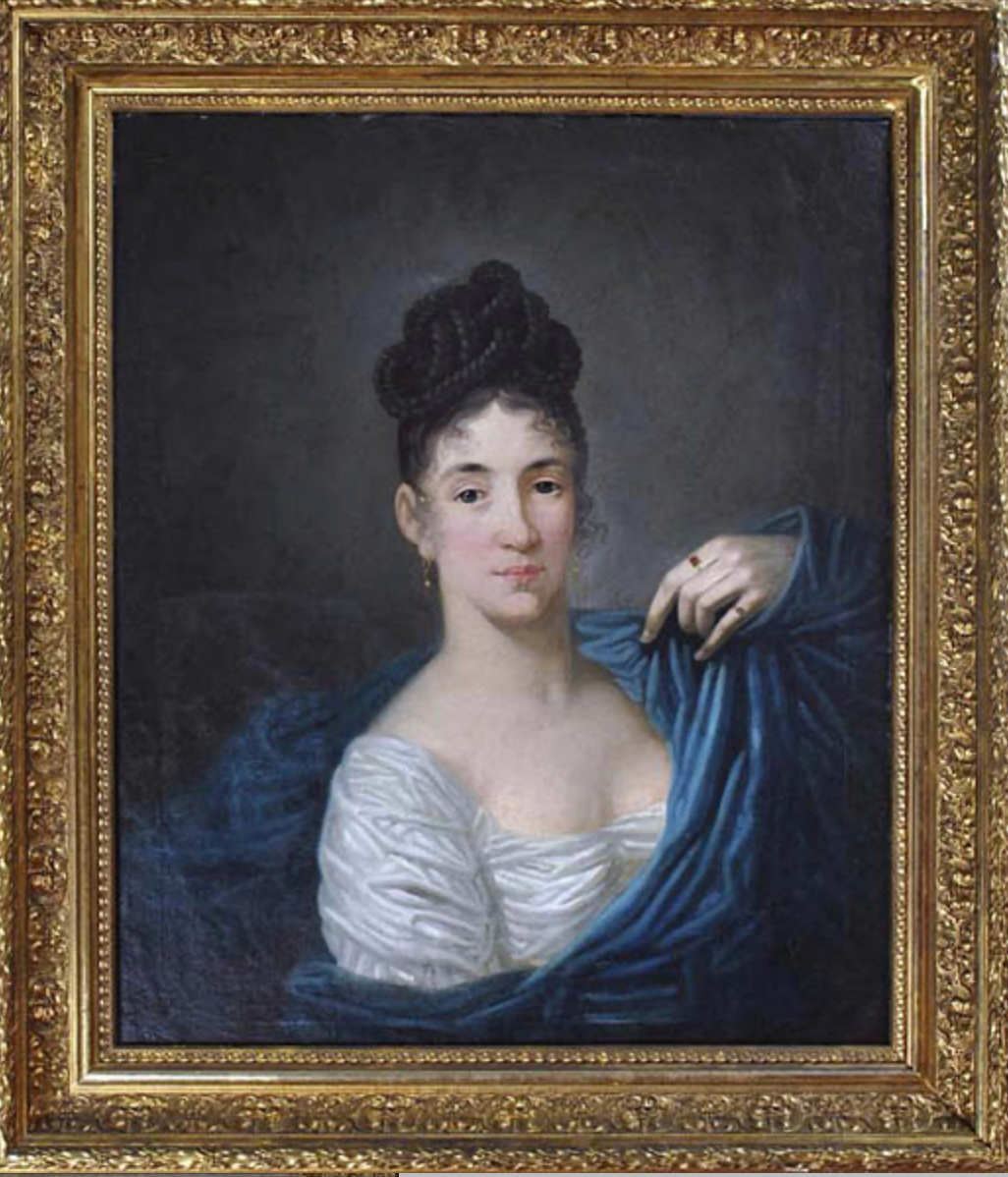
Some works become interesting not because their history is dramatic, but because a small amount of surviving information opens a much larger trail. Daniel Kondratowicz’s Portrait of Józefa née Kierska Moraczewska, painted in 1816, is one of those paintings.
Kondratowicz (1765–1844) was a portraitist, painter of historical and allegorical subjects, and also a conservator. Historical sources connect him closely with the artistic circle of Franciszek Smuglewicz. He is described as having been born in Samogitia, having spent a short period studying in Vilnius, and from 1786 working in Smuglewicz’s Warsaw studio. That background places him within the same wider Polish-Lithuanian artistic world that is central to much of our research.
The portrait itself is a refined example of early nineteenth-century private portraiture. Józefa is shown half-length, dressed in white and wrapped in a deep blue shawl. The pose is composed and restrained, but the small details — the jewellery, the hand resting against the fabric, the direct expression — give the painting a distinctly personal character.
What makes the work particularly valuable for provenance research is the handwritten note preserved on the stretcher. It identifies the sitter as Józefa née Kierska, daughter of Józef Kierski of the Jastrzębiec coat of arms and Ludwika Zakrzewska. The inscription records her as the wife of Tomasz Moraczewski, owner of the Zielątkowo estate, and also lists members of the next generation of the family. Artinfo further identifies her as having first been married to Antoni Świnarski and later to Tomasz Moraczewski of the Cholewa coat of arms.
Such inscriptions can be as important as signatures. They preserve information that may disappear from later catalogues and can connect a painting directly to a family, an estate and a network of descendants. In this case, the reverse of the canvas effectively carries a compact family archive with it.
The work is recorded in the Artinfo archive as lot 65 and is described as oil on lined canvas, 65.5 × 54.5 cm, after conservation. The open record does not disclose the later ownership history, and the subsequent provenance is therefore still a point of interest in our research.
Kondratowicz is represented in museum collections, but works of this type are still relatively little known outside specialist circles. The portrait is a good example of why seemingly modest archival traces matter: a single image, an old inscription and a name can be enough to reconnect a work with a much broader historical context.
Comments & research notes
Share what you know
If you recognise this work, artist or object, know of a related example, or simply wish to leave a comment, you are welcome to do so anonymously.
Loading comments…
Public comments are contributions from visitors and do not represent The Missing Canvas. Inaccurate, abusive or inappropriate comments may be removed.