
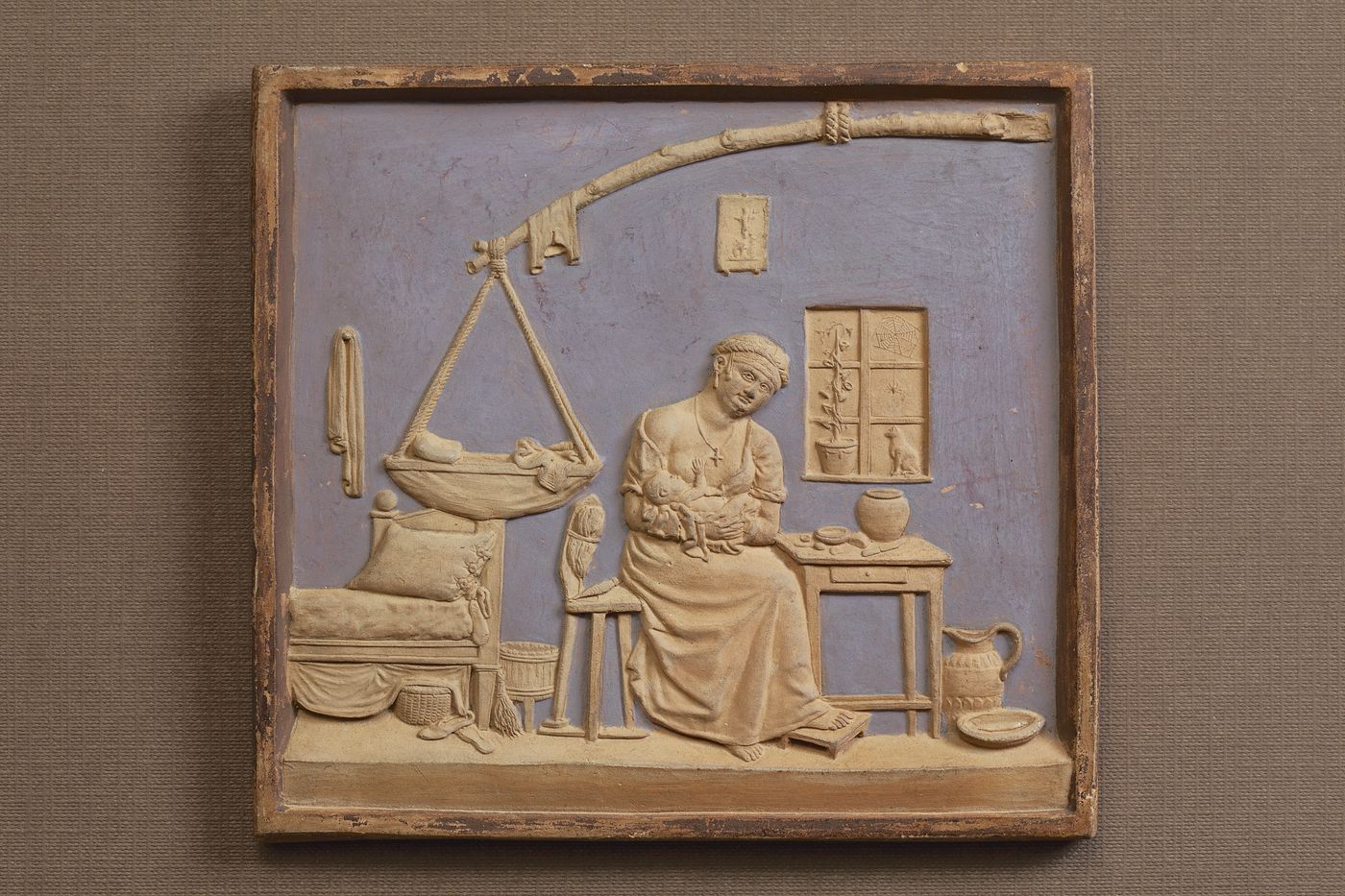
In 1943, Paulius Galaunė, then director of the museum in Kaunas, acquired a small terracotta relief from an antiquarian shop in Vilnius. Measuring approximately fourteen by thirteen centimetres, the work depicted a woman nursing a child in a modest domestic interior. Despite its size, the room was rendered with extraordinary attention: a cat on the windowsill, a spider suspended in its web, a cradle, a few pieces of furniture and the scattered necessities of daily life. The relief, now known as Motherhood (Macierzyństwo or Motinystė), belonged to the work of Ignacy Julian Ceyzik, a figure little known beyond specialists in nineteenth-century ceramics. It also offered a clue to one of the strangest careers associated with the early Vilnius School of Art.
Ceyzik was born in 1779, probably in the Podlasie region, although the precise place remains disputed. Some sources point towards Sejny, others to Łysków, now in Belarus, or to Liškiava in present-day Lithuania. Such uncertainties are not unusual in the biographies of artists whose lives unfolded across the former lands of the Grand Duchy of Lithuania. His name, too, appears in various forms—Ceyzik, Cejzyk, Cejzik and, in Lithuanian, Ignotas Ceizikas—an important complication when tracing archival documents and surviving works.
An Unconventional Pupil of the Vilnius School
In 1798 Ceyzik entered the drawing and painting classes associated with Vilnius University, studying under Franciszek Smuglewicz (1745–1807), one of the founders of professional artistic education in Lithuania. Having trained and worked in Rome, Smuglewicz brought a sophisticated understanding of classical composition, figure drawing and historical painting to Vilnius. His department formed the nucleus of what later became known as the Vilnius School of Art, an institution whose influence extended well beyond the city and continued long after the university’s closure in 1832.
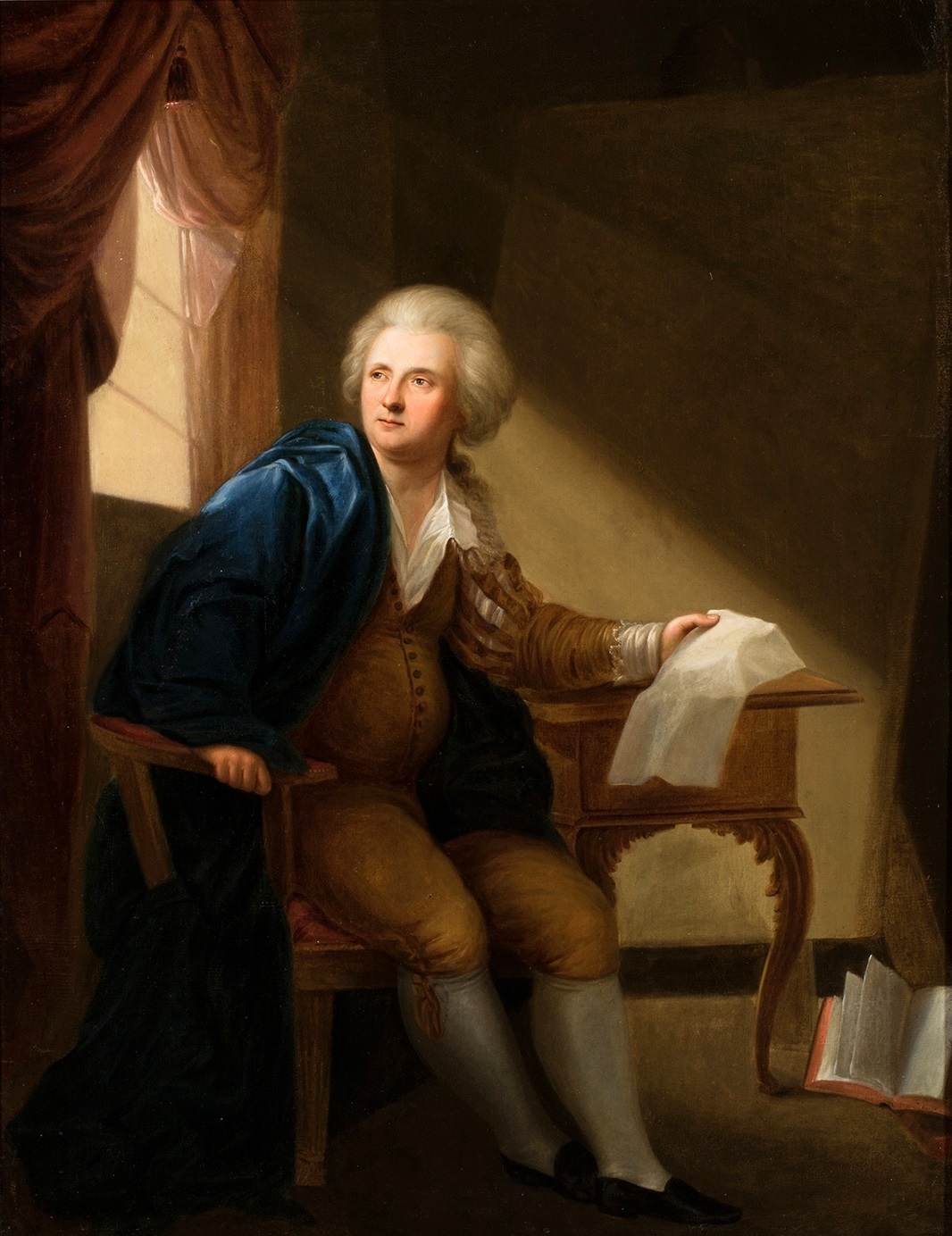
Jan Rustem (1762–1835), appointed Smuglewicz’s adjunct in the same year that Ceyzik entered the school, was another central figure in this environment. Rustem’s teaching would shape a generation of painters, particularly through portraiture and close observation of character. His presence is relevant to the artistic culture in which Ceyzik studied, although the available biographical evidence identifies Smuglewicz as Ceyzik’s teacher; it does not establish that Rustem personally instructed him. Nor should Ceyzik be confused with an artist who completed a conventional academic course. According to later biographical research, he interrupted his studies, returned to drawing and painting classes around 1802, and attended lectures in chemistry, history and French without obtaining a degree.
Those varied interests help explain an unusual combination of abilities. Ceyzik was an accomplished draughtsman and calligrapher, capable of preparing elaborate university diplomas for which he was reportedly paid substantial fees. He also worked in the university administration. The knowledge of chemistry and the exceptionally accurate hand that served his artistic work were to become significant in another, less respectable profession: the manufacture of forged documents and banknotes.
Vilnius was also where he became acquainted with painters Józef Oleszkiewicz and Jan Damel. They belonged to a wider circle of freethinkers, scholars and artists whose discussions touched on philosophy, science and politics. A memoir by Antoni Andrzejowski, who had studied with Oleszkiewicz, places Ceyzik among the visitors to these gatherings. This association locates him firmly within the intellectual and social world of the Vilnius School, even though his mature work would eventually take a very different form from the portraits and historical paintings produced by many of its better-known pupils.
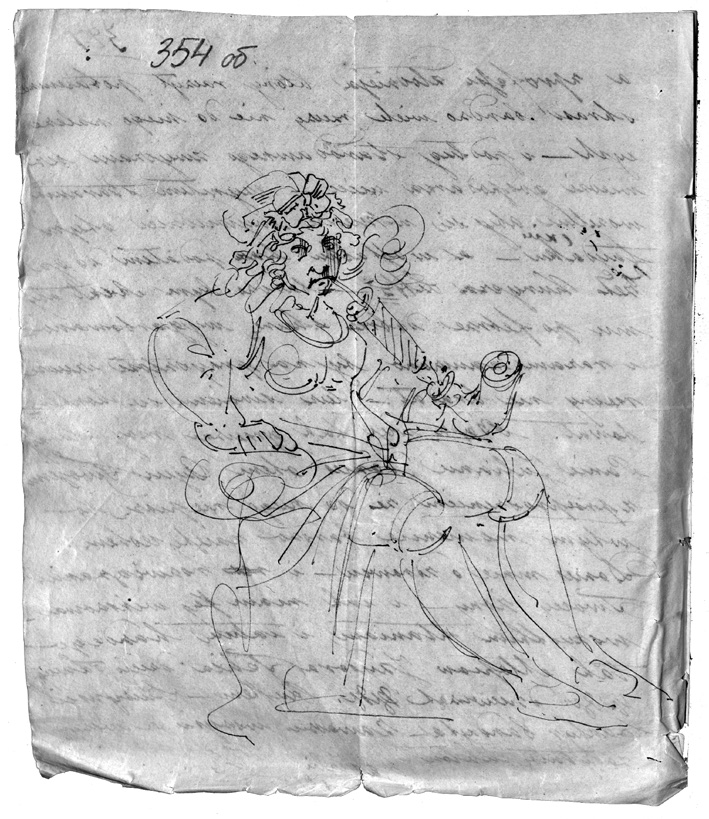
The Forgery Case and an Artist in Prison
Ceyzik’s counterfeiting was not an isolated lapse in an otherwise conventional artistic life. While still associated with Vilnius, he was already making imitation theatre tickets; after moving to the Slonim region, the enterprise developed into the production of Russian paper money. The police investigation began in 1814, when paper apparently intended for forged banknotes was discovered in an attic at Hanusowszczyzna. Ceyzik, his brother Feliks and several associates were arrested, and the subsequent proceedings attributed roughly 65,000 roubles in counterfeit notes to their operation. His connections with the Vilnius artistic circle had unwelcome consequences: Damel was implicated in supplying paper and was also sentenced to exile.
Later accounts sometimes present Ceyzik’s counterfeiting as a deliberate attempt to weaken the finances of the Russian Empire. He himself invoked political arguments in defending his actions, but there is no reason to treat this explanation as established fact. The considerable sums involved, the repetition of the offence and the testimony preserved in nineteenth-century memoirs leave room for financial motives as well. To turn him into an uncomplicated patriotic hero would be to lose the very contradictions that make his biography interesting.
The sequence of arrests and escapes is unusually revealing. On 15 July 1819, after several years in Slutsk prison, Ceyzik and his companions escaped and made their way to Vienna, where they resumed the same trade, now forging Austrian banknotes. When the Viennese police began to investigate, they returned east and continued their activities under assumed names in Podolia. Ceyzik called himself Jakub Czudowski. In January 1821, Feliks Ceyzik and Dominik Korzun were caught in Kobryn while passing false notes, an arrest that led the authorities back to Ignacy. The Senate had imposed a severe sentence in 1820; after further proceedings, it was upheld in 1828, and Ceyzik was sent into exile in Siberia. The earlier prosecution had failed to put an end to his activities, which had resumed across borders and under false identities.
The period of imprisonment nevertheless proved important to his artistic development. Lacking ordinary workshop materials, he fashioned figures and reliefs from clay or improvised mixtures, at times using bread, ash and plaster. Contemporary accounts describe him working with needles, sharpened pieces of metal and other rudimentary implements. His subjects ranged from plants and animals to biblical figures and intimate scenes of confinement. The technical precision he had acquired in Vilnius was applied to objects that could be produced on an improvised workbench rather than an academic easel.
An exceptional survival from this early period is a vase dated 1818, now in the Museum of the Jagiellonian University in Kraków. Conservation research by Magdalena Szyszlak, drawing on a manuscript by the vase’s former owner Aleksander Jelski, has connected its imagery with an appeal to Tsar Alexander I for Ceyzik’s release. The vessel bears an engraved signature, Ignace Ceyzik. Its significance goes beyond the unusual circumstances of its manufacture: it shows that his experiments with coloured relief, burnished surfaces and symbolic decoration were already highly developed before his permanent exile.
A Ceramic Workshop in Siberia
In Siberia Ceyzik’s skill became both a livelihood and, for a time, a protection from the worst consequences of his sentence. He worked in the Tobolsk region, producing vases, cups, pipes, portrait reliefs and small figures whose surfaces could resemble dark stoneware or polished stone. The black and brown ceramic bodies invited comparison with the fashionable wares of Josiah Wedgwood, although Ceyzik’s methods and ornaments were distinctly his own. His compositions often combined neoclassical forms with miniature creatures, foliage, allegorical figures and episodes of everyday life, sometimes on the same vessel.
His technique attracted considerable curiosity. Later writers recorded that he guarded the preparation of his ceramic material as a secret and had been offered a large sum of money for the formula, which he allegedly refused unless he could obtain permission to return home. Modern conservation analysis has illuminated aspects of his working process, including the grinding, polishing and treatment of the clay before firing. The old descriptions of a miraculous secret glaze should therefore be understood alongside the material evidence of the objects themselves.
The artist also found patrons among other exiles. Piotr Moszyński, a Polish nobleman and collector deported to Tobolsk, supported him financially, and Ceyzik modelled his benefactor’s portrait. The memoirist Ewa Felińska visited Ceyzik in Tobolsk and described the modest house and carefully tended garden he had acquired. These recollections suggest an artist who was neither an isolated prisoner nor an unrecognised craftsman: he had clients, a household, a working reputation and, for a period, a measure of comfort. His ceramics circulated through a network of officials, fellow exiles and private collectors.
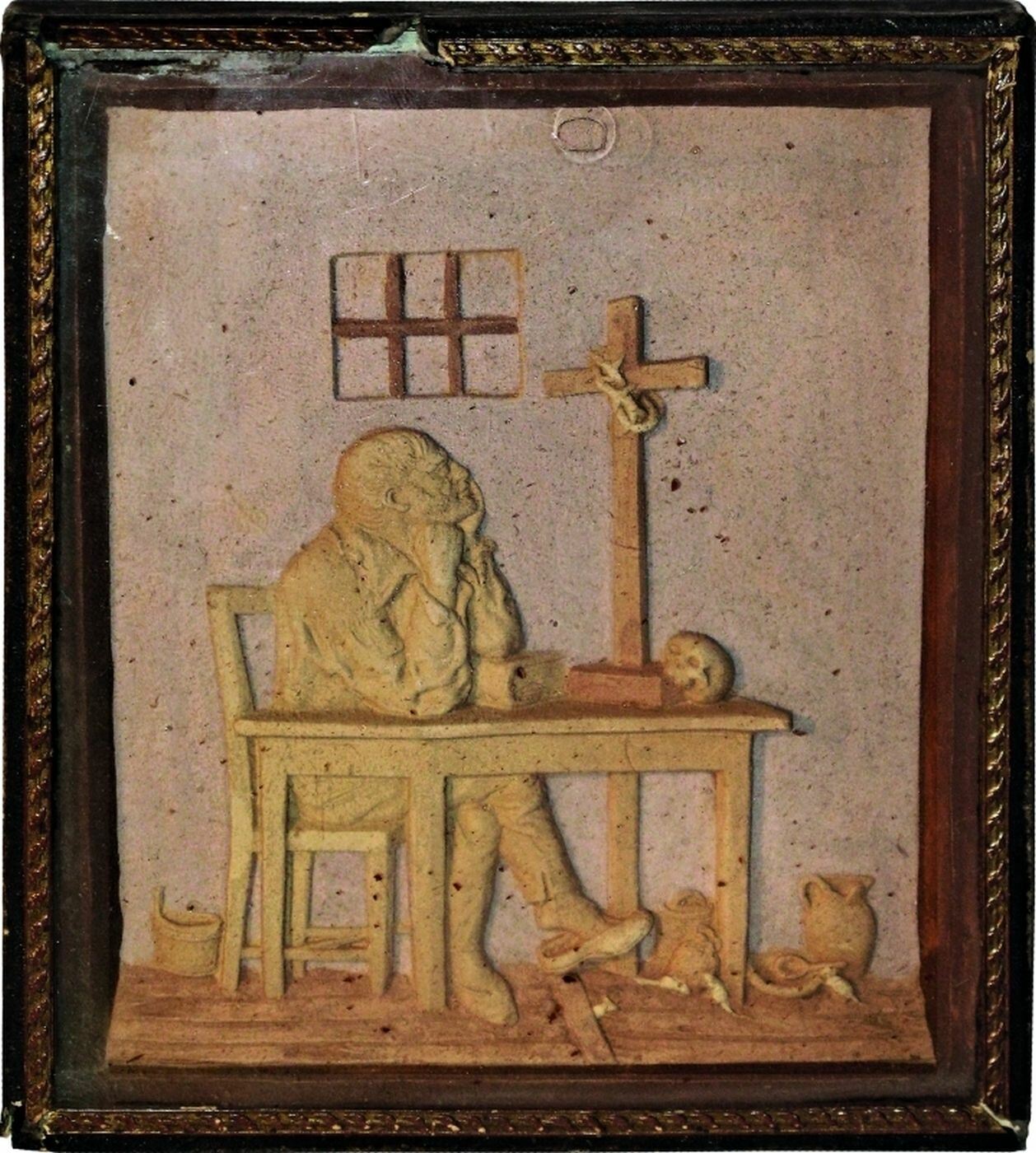
That stability did not last. Even after acquiring a house, a garden and an established clientele in Tobolsk, Ceyzik returned to making counterfeit banknotes. In 1846 he was reportedly caught in the act and was again punished, this time with hard labour at the Akatuy mines in Transbaikalia. The pattern is difficult to overlook: an investigation in 1814, renewed forgery after the escape of 1819, another arrest following the events of 1821, and a further offence in Siberia decades later. His skill brought him recognition and prosperity, yet he repeatedly risked losing both. Even under penal conditions, however, he continued to make art; among the works associated with this period is a relief depicting prisoners at the mine, including a figure shackled to a wheelbarrow. Other compositions show an inmate contemplating a crucifix or a woman approaching a prison window with a child. These are valuable not simply as illustrations of a dramatic biography but as unusually personal documents of imprisonment, made by an artist who had experienced the conditions he represented.
After years of penal labour, Ceyzik was allowed to settle elsewhere in eastern Siberia and eventually moved to Irkutsk in 1857. Sources disagree whether he died in 1858 or around 1860. One of the most revealing accounts of his final years comes from Agaton Giller, who met him in Siberia and described an ageing man still occupied with drawing and modelling despite failing eyesight and declining health. Giller admired the quality of the reliefs, while recognising that the need to earn a living had sometimes forced Ceyzik into rapid, repetitive production.
The Works That Returned—and Those Still Missing
Ceyzik’s place in the history of Lithuanian art is more substantial than his relative obscurity might suggest. Although trained in the Vilnius School’s drawing and painting tradition, he developed an independent career in sculpture and ceramics, bringing an academic sense of design to materials usually discussed under the heading of decorative art. Works by him are preserved in Lithuania, including in the Lithuanian National Museum of Art and the M. K. Čiurlionis National Museum of Art, while Polish collections include the National Museums in Warsaw and Kraków, the Museum of King Jan III’s Palace at Wilanów, and the Jagiellonian University Museum. A black cup decorated with a coloured butterfly in the Wilanów collection provides a particularly fine example of his delicate treatment of natural forms.
Other groups of works have histories that remain less clear. Onufry Pietraszkiewicz, a member of the Vilnius Philomath circle, assembled a collection of Ceyzik’s terracottas in Tobolsk; this group later reached Vilnius and was associated with his nephew, Dr Jan Pietraszkiewicz. Individual pieces were also recorded in the collections of Moszyński and other nineteenth-century owners. The subsequent dispersal of these holdings, and the wide distribution of Ceyzik’s ceramics across the former Russian Empire, leave important questions for provenance research.
The recurrence of his prison imagery is particularly interesting. A second version of Ceyzik in Prison, now held by the Lithuanian National Museum of Art, depicts a similarly seated prisoner with a barred window, crucifix and skull. The two museum pieces are not the same object, and similarities between them should not be taken as proof that both were produced from one mould. They do, however, demonstrate how closely the subject of imprisonment became associated with his ceramic work.
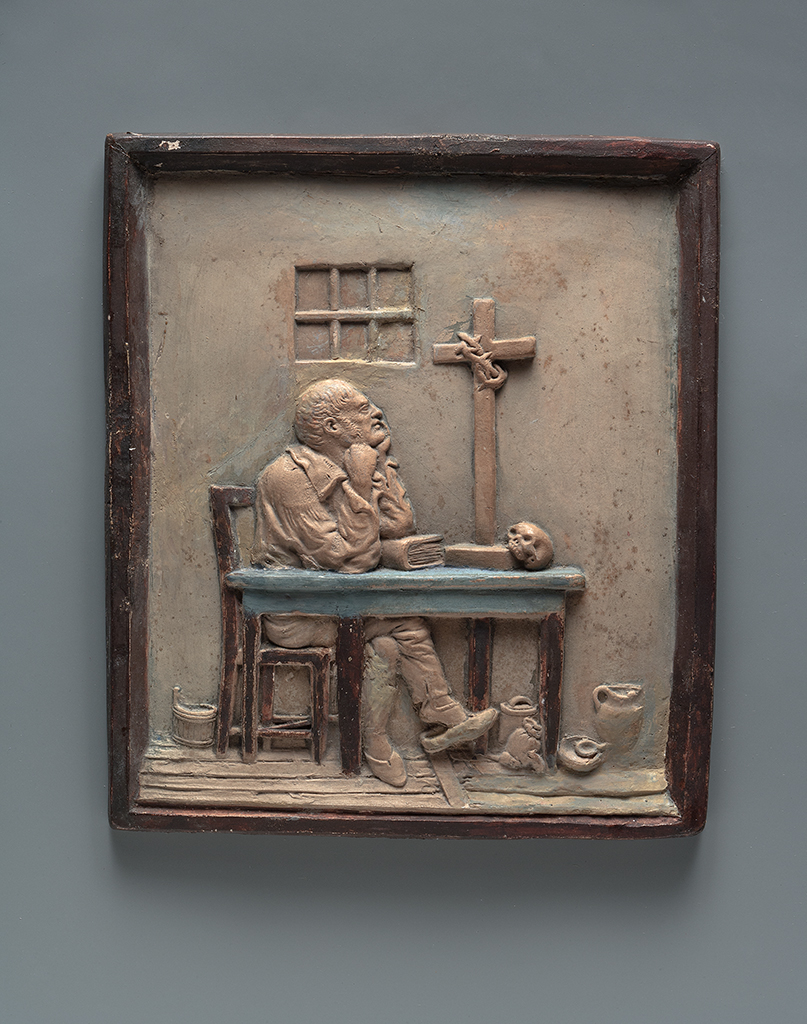
Attribution is another difficulty. Ceyzik used moulds, and members of his household continued to produce objects from them. His popularity also encouraged imitation, including objects carrying his name but not necessarily made or finished by his own hand. A signature, even where present, cannot by itself resolve the problem. For collectors and museums, questions of technique, surface finishing, documented provenance and comparison with securely recorded examples are especially important.
The small relief acquired in Vilnius in 1943 remains an appropriate introduction to Ceyzik’s art. It is an object of exceptional detail, but it also belongs to a history of movement: from the Vilnius School to the prisons of the Russian Empire, from Siberian workshops into family collections and, in some cases, back to Lithuania and Poland. Ceyzik deserves to be studied as a serious artist in his own right, not merely as a talented counterfeiter with an extraordinary life. His surviving ceramics, and the many works whose locations have yet to be established, provide ample grounds for further research.
Research and private collections
Ceyzik’s works are still encountered in private hands, often without a secure attribution or complete provenance. We welcome information about ceramics, reliefs, family collections or archival records connected with the artist. Contact The Missing Canvas.
Sources and further reading
- Ernest Szum, “Ignacy Cejzyk – z Podlasia na Syberię (1779–1858). Szkic portretu biograficznego,” Białostockie Teki Historyczne 10 (2012). https://repozytorium.uwb.edu.pl/jspui/bitstream/11320/884/1/BTH_10_2012_Szum.pdf
- Beata Mróz, “Ignacy Julian Ceyzik (1779–ok. 1860). Artysta rzeźbiarz, fałszerz carskich banknotów, zesłaniec.” https://repozytorium.uwb.edu.pl/jspui/bitstream/11320/8470/1/B_Mroz_Ignacy_Julian_Ceyzik.pdf
- Henryk Mościcki, “Ceyzik Ignacy Julian,” Polski Słownik Biograficzny, vol. III. https://www.ipsb.nina.gov.pl/a/biografia/ignacy-julian-ceyzik-h-owada-1779-860-rzezbiarz-i-ceramik
- Magdalena Szyszlak, “The restoration of the vase by Ignacy Ceyzik dated 1818 from the collections of the Museum of Jagiellonian University,” in the Kraków Academy of Fine Arts conservation publication. https://wk.asp.krakow.pl/wp-content/uploads/2016/02/2016-01-11_ASP_pr-mag_T-2_str-int.pdf
- Lithuanian National Museum of Art, “Vilnius Art School and Its Traditions.” https://www.lndm.lt/en/vpg/expositions/
- Museum of King Jan III’s Palace at Wilanów, ceramics collection: “Pucharek z motylem.” https://w-ww.wilanow-palac.pl/ceramika
- Visuotinė lietuvių enciklopedija, “Ignotas Julijonas Ceizikas.” https://www.vle.lt/straipsnis/ignotas-julijonas-ceizikas/
- LIMIS (Lithuanian Integral Museum Information System), Plaketė „Motinystė“, catalogue record of the National M. K. Čiurlionis Museum of Art. Museum record and photograph.
- LIMIS, Skulptūrinis reljefas, catalogue record of the Lithuanian National Museum, dated 1818. Museum record and photograph.
- Lithuanian National Museum of Art, Dekoratyvinė plokštelė „Ceizikas kalėjime“, tinted-clay relief, collection catalogue. Museum record and photograph.
Comments & research notes
Share what you know
Have you encountered a Ceyzik ceramic, an old inventory or a related family archive? Share a research note.
Loading comments…