
The Lithuanian Statutes are usually discussed as legal texts. They are also physical objects: manuscripts and printed books that passed through courts, noble libraries, family collections and, eventually, public institutions. Their survival is therefore a story of law, but also of provenance.
The First Statute — 1529
The First Lithuanian Statute came into force in 1529 as the first comprehensive codification of law for the Grand Duchy of Lithuania. It was not printed at the time. Instead, it circulated in handwritten copies, principally in the Ruthenian chancery language of the state and later in Polish and Latin translations.
The original manuscript has not survived. Only seven manuscript copies are generally recognised as surviving today. That number is strikingly small for a code that had to be used in practice across a large state. More copies certainly once existed; some disappeared from the documented record, while others may have been destroyed or absorbed into collections under different descriptions.
The Second Statute — 1566
The Second Statute substantially expanded and revised the earlier code. It reflected the political, judicial and administrative reforms of the Grand Duchy in the decades before the Union of Lublin and regulated a more developed system of courts and noble self-government.
Like its predecessor, it initially circulated in manuscript form. Roughly fifty-eight manuscript witnesses are known today in Ruthenian, Polish and Latin. Many of them have complicated ownership histories: copies that once belonged to noble or scholarly libraries later entered major institutional collections.
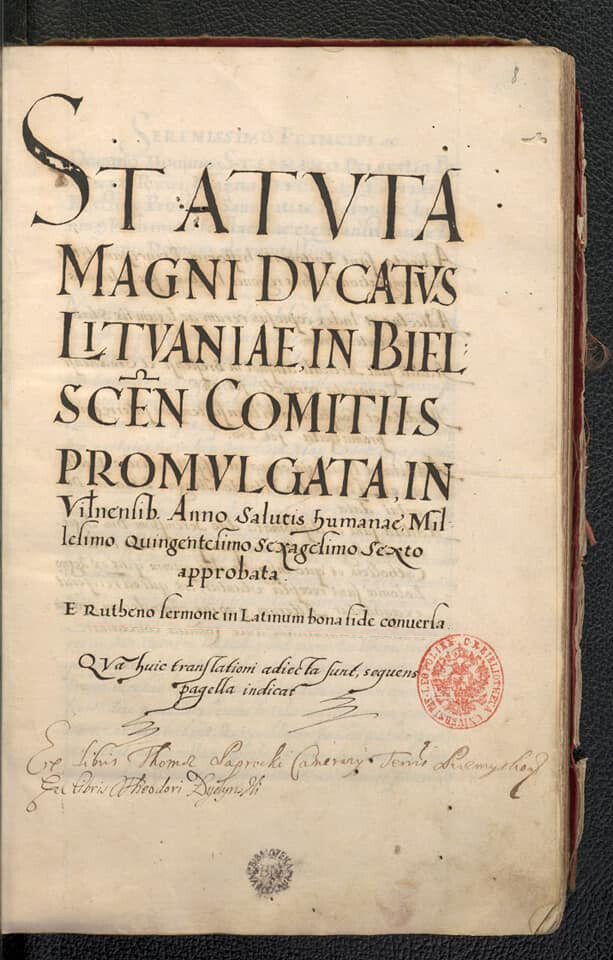
A Latin translation produced in 1576, associated with Augustinus Rotundus, is an important reminder that the Statutes were not isolated provincial law books. They were part of a wider European legal and political culture and were copied, translated and preserved in several languages.
The Third Statute — 1588
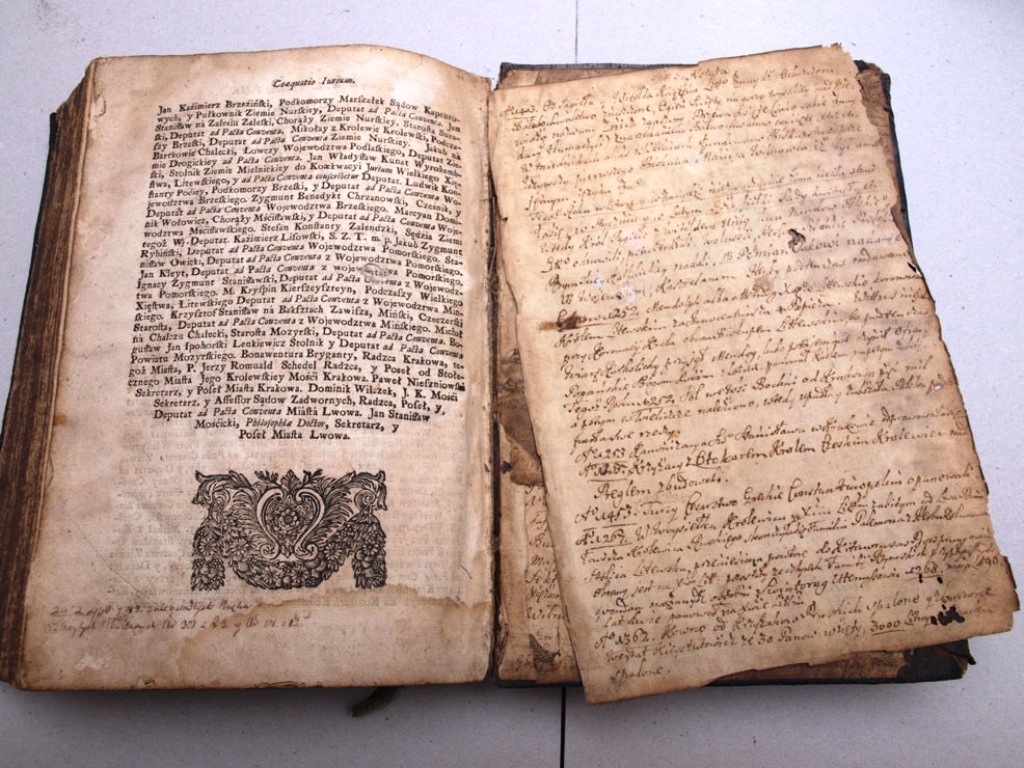
The Third Lithuanian Statute was approved in 1588 and represented the mature form of the legal system of the Grand Duchy. Unlike the first two Statutes, it was printed. The early Cyrillic editions were produced in Vilnius by the Mamonich press, turning a manuscript legal tradition into a printed one.
The Third Statute remained in force for more than two centuries, surviving the partitions of the Polish-Lithuanian Commonwealth and continuing to operate in former lands of the Grand Duchy until its final abolition by the Russian Empire in 1840. Because it was printed, substantially more copies survive than of the First or Second Statutes, although early editions remain important historical and bibliographical objects in their own right.
From law to provenance
The three Statutes show a clear progression: the First Statute survives through a tiny group of manuscripts; the Second through a broader manuscript tradition; and the Third through printed editions that circulated much more widely.
But numbers alone do not tell the whole story. Every surviving manuscript or early printed copy has an individual history. It may have moved through an estate library, changed hands by inheritance, been displaced by war, entered an antiquarian collection or disappeared from catalogues for generations.
This is where the Statutes become relevant to the wider research of The Missing Canvas. Books and manuscripts can disappear from public view in much the same way as paintings. A work does not need to be destroyed to become lost; sometimes it simply passes into private hands and stops being documented.
The First Statute makes that question particularly clear. Seven copies are known today. More once existed. Where did the others go?
Do you know of a surviving copy? The Missing Canvas is actively seeking to acquire an original manuscript or early printed copy of any of the three Lithuanian Statutes if one is lawfully available for private sale. We would be particularly interested to hear of copies that have remained in family libraries, private collections or outside the standard scholarly record.
Information is equally valuable. A copy does not need to be for sale. We invite confidential contact from owners, descendants, researchers, librarians, antiquarian booksellers and anyone who has seen or heard of a Statute in private hands. Old photographs, estate inventories, library catalogues, auction references, inscriptions, bookplates and family records may all help trace a copy whose present whereabouts are uncertain. Please contact us if you can help.
Comments & research notes
Share what you know
If you know of a manuscript, early printed copy or provenance record connected with the Lithuanian Statutes, you are welcome to leave a note.
Loading comments…