
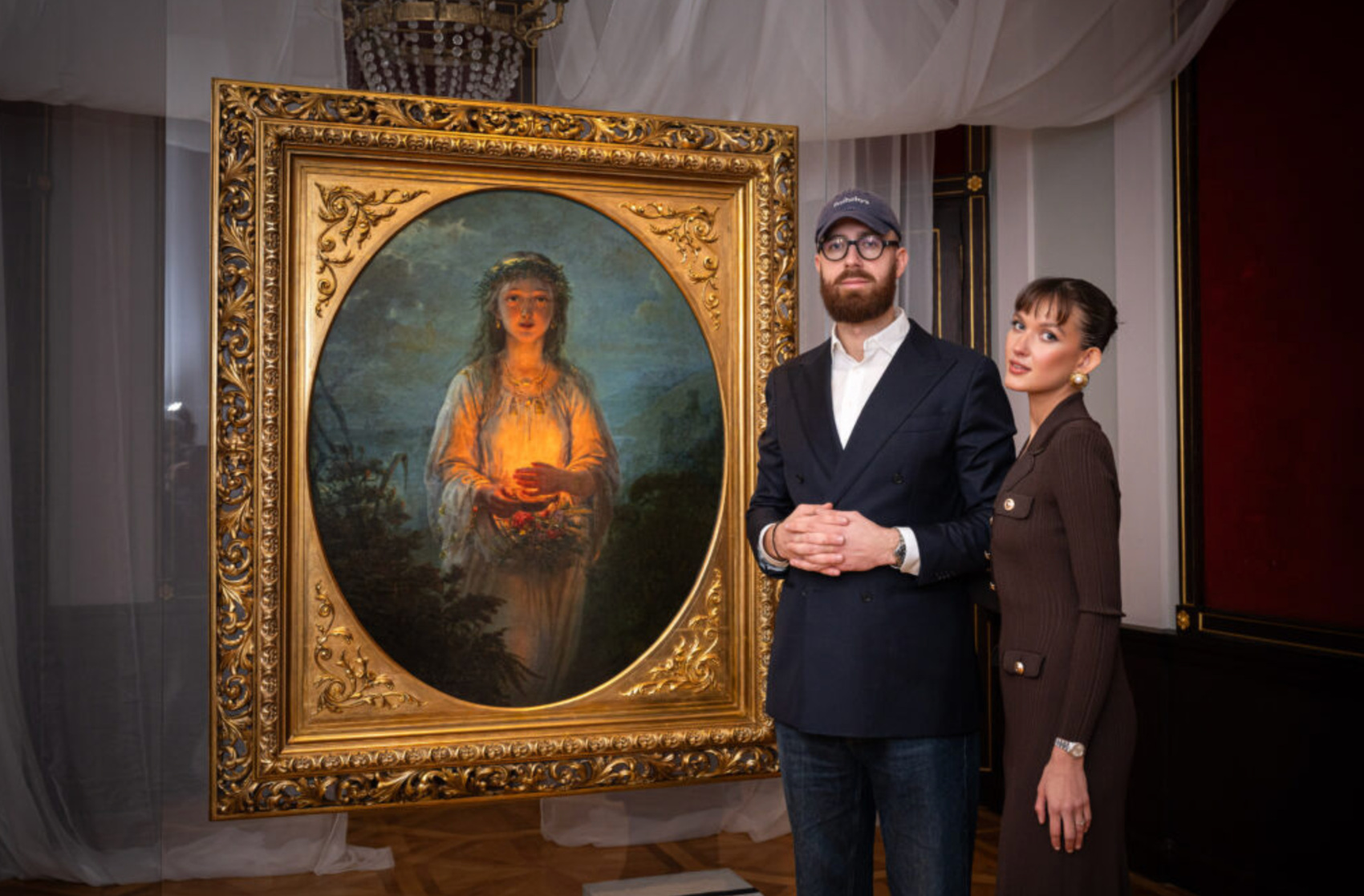
Wincenty Sleńdziński’s Vaidilutė was painted in Dresden in 1873. For more than 150 years, the painting remained in private hands outside Lithuania. In 2025, after an unexpected approach, months of uncertainty and a journey to Poland, we were finally able to acquire the work and bring it to Lithuania.
Sleńdziński was born in 1838 and belonged to one of the most important artistic families connected with nineteenth-century Vilnius. He studied first with his father, Aleksander Sleńdziński, and Kanuty Rusiecki before continuing his artistic education in Moscow. His life and career were deeply affected by the political events surrounding the 1863 uprising. Because of his connections with its participants, he was exiled and spent many years away from Lithuania.
After almost eight years in Knyaginin and Kharkiv, Sleńdziński was temporarily permitted to leave. From 1872 he spent time in Kraków and Dresden, before being forced back into exile again in 1875. Vaidilutė was painted during this relatively short period in Dresden.
The painting is closely connected with the nineteenth-century romantic fascination with Lithuania’s pre-Christian past. Sleńdziński depicts a young pagan priestess holding a glowing lamp, surrounded by a quiet and slightly mysterious landscape. Baltic ornaments, plants gathered in her lap and the distant landscape all connect the figure with an imagined ancient Lithuania.
The subject becomes even more interesting when considered in the context of the artist’s own life. Sleńdziński was living away from home when he painted it, and it is difficult not to see something of exile, memory and longing in the work.
What makes Vaidilutė particularly remarkable is that much of its early history can still be reconstructed. In 1873, the painting was purchased directly from Sleńdziński’s studio by Count Mieczysław Kwilecki and his wife Maria. It later hung at their estate in Grodziec, Poland. An inscription preserved on the reverse of the painting records this connection.
After the Second World War, the work passed into clerical hands. Around 1972 or 1973, it was acquired by Father Wojciech Krzywański, who would keep it for more than fifty years.
The painting was not entirely forgotten during this period. Ludomir Sleńdziński, Wincenty’s son and an important painter himself, knew the work and reportedly considered it one of his father’s finest paintings. He attempted to acquire Vaidilutė more than once, but without success. On one occasion, he is said to have offered several of his own works in exchange.
The painting remained where it was.
Our involvement began with a message and several photographs of extremely poor quality. From those images alone, it was difficult even to determine exactly what we were looking at. The painting appeared interesting, but with a work that had remained outside the public art market for so long, a signature and a few photographs were not enough. The provenance had to make sense, the physical object had to be examined and the painting itself had to correspond with what was known about Sleńdziński’s work.
The process took several months. During that time there was also interest from the Sleńdziński Gallery in Białystok, which meant there was no certainty that we would ultimately be able to acquire the painting.
Eventually, we travelled to Poland to see it ourselves.
The circumstances could hardly have been further removed from the way an important nineteenth-century painting is normally encountered. Vaidilutė was being kept on the priest’s property in an old, largely unused building. After months of seeing only unclear photographs, finally standing in front of the original was something completely different.
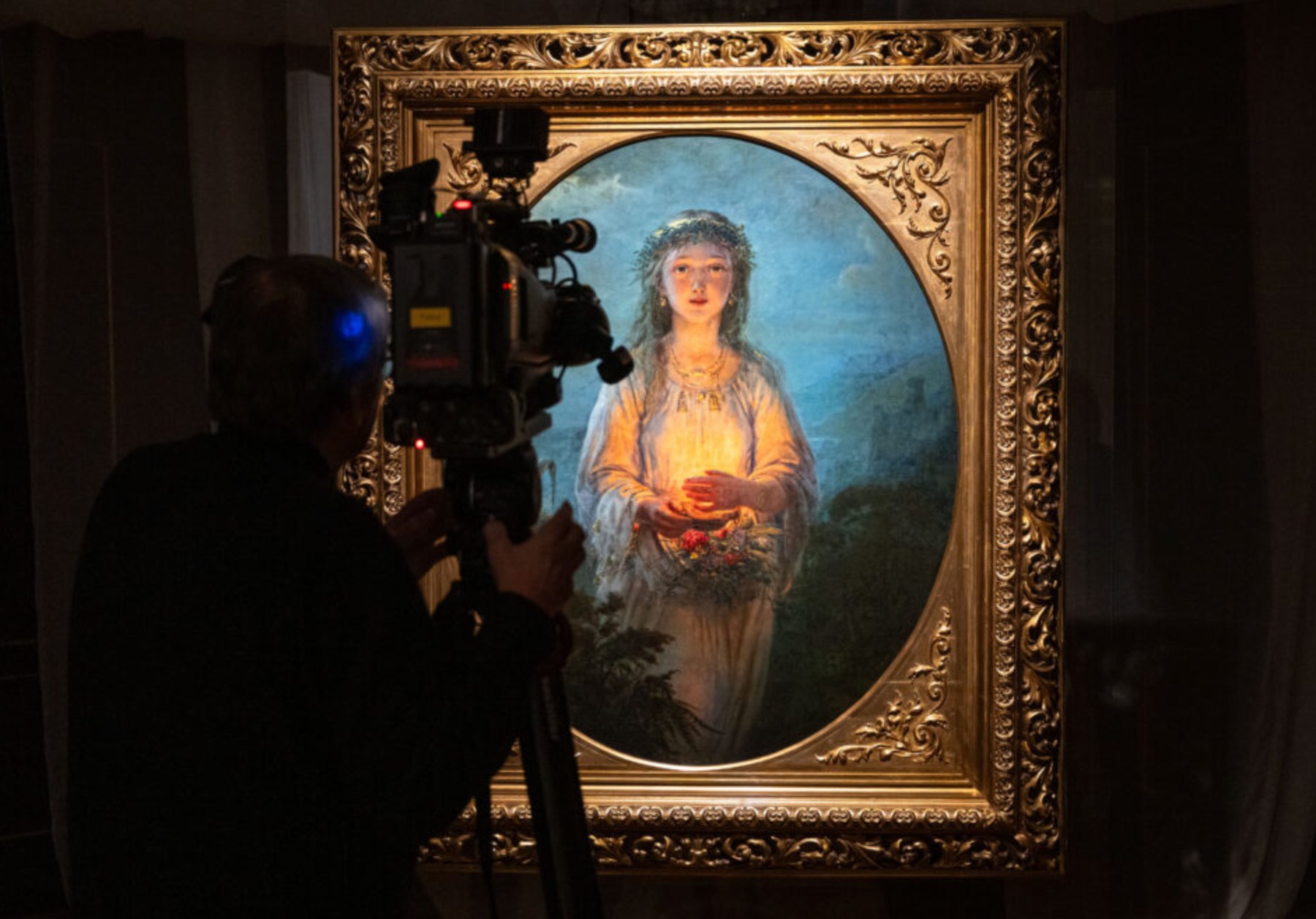
Even beneath a heavily yellowed layer of old varnish, the painting had an immediate presence. The quality of the face, the atmosphere of the landscape and the light within the composition were impossible to understand properly from the photographs.
We acquired Vaidilutė from Father Krzywański in 2025 and brought it to Lithuania.
Bringing the painting back was, however, only the beginning of the story. It was examined by restoration technology specialist Rapolas Vedrickas and subsequently conserved by Linas Lukoševičius and Virginija Murmaitė.
The old varnish had darkened considerably over time, obscuring both the colours and many details of the composition. As the varnish was carefully reduced, the painting slowly began to reveal itself again. Clouds became clearer, the shoreline emerged and the distant landscape regained depth and definition.
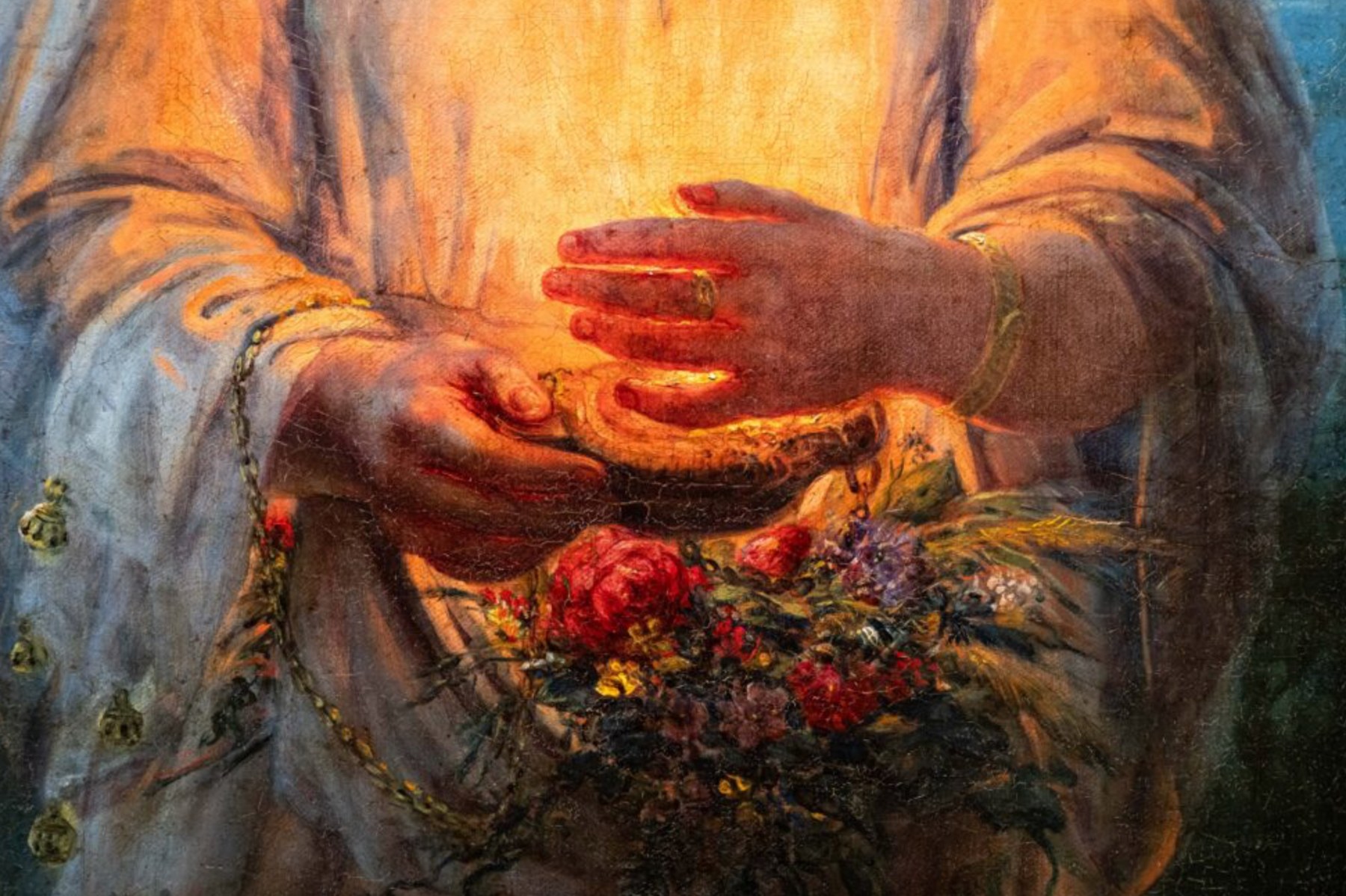
Then something particularly unexpected appeared: a castle in the distance.
It had been so heavily obscured that before conservation it was barely visible. Its appearance was a reminder that even when a painting itself survives, parts of it can effectively remain lost for generations.
There is also an intriguing question surrounding the identity of the young woman. We have wondered whether Sleńdziński may have had Birutė in mind — the legendary priestess who later became the wife of Grand Duke Kęstutis.
There is no documentary evidence confirming this, so it remains an interpretation rather than a fact. Nevertheless, the face of the figure in Vaidilutė bears similarities to Sleńdziński’s representation of Birutė in another composition, Kęstutis Abducts Birutė. Whether she represents Birutė specifically or an idealised pagan priestess, the work is unmistakably rooted in the nineteenth-century imagination of Lithuania’s ancient past.
In December 2025, Vaidilutė was presented at the Vilnius Picture Gallery of the Lithuanian National Museum of Art. It was the first time the painting had ever been publicly shown in Lithuania, more than 150 years after it was painted. The exhibition ran from 9 December 2025 until 22 February 2026.
The presentation itself was unusually ambitious for an exhibition centred on a single painting. Rather than simply placing Vaidilutė on a gallery wall, a separate architectural installation was created around it. The painting was positioned within a glass wall anchored into a concrete base and surrounded by soft white forms reminiscent of clouds or feathers, giving the impression that the work was almost suspended within the space.
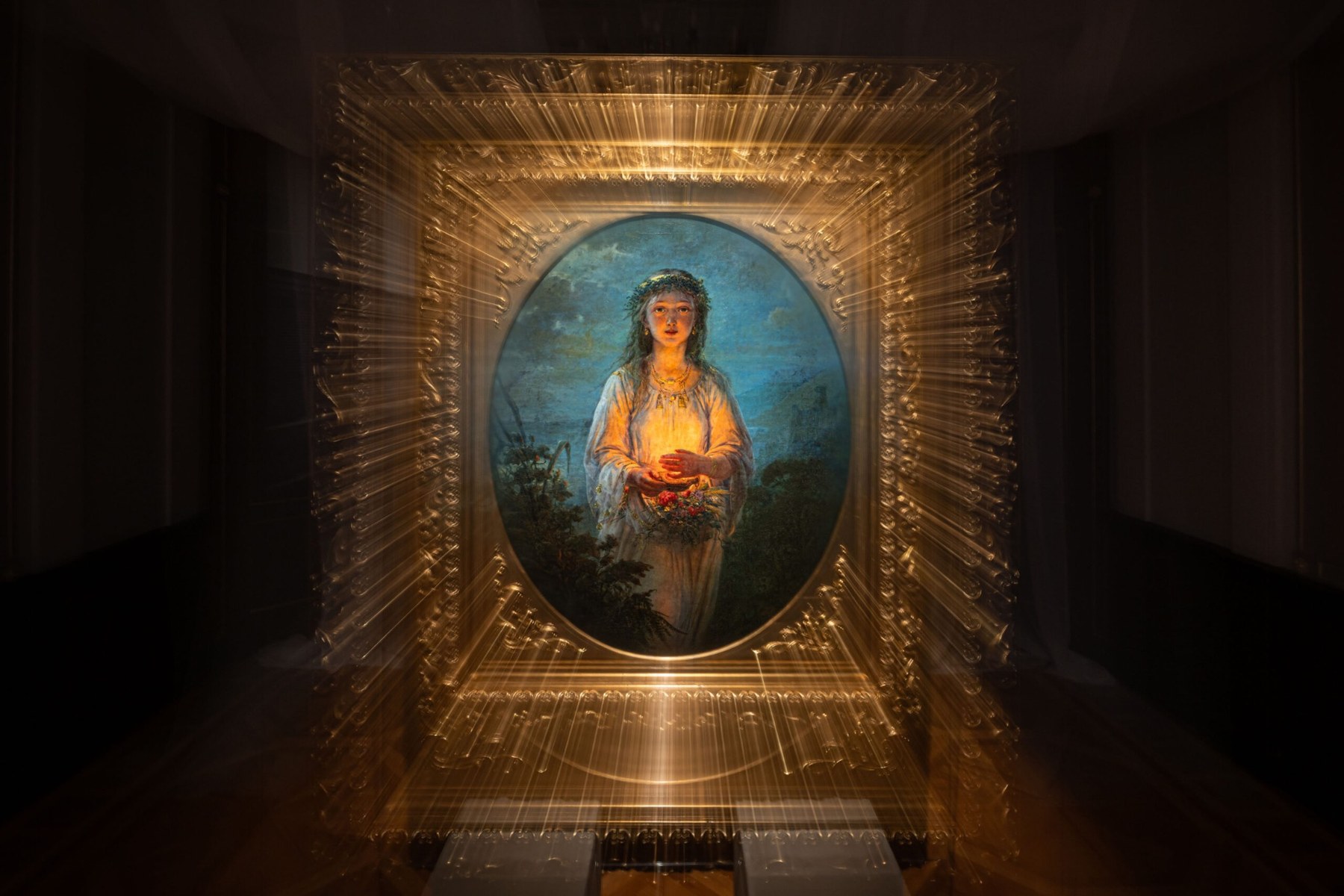
The installation was designed by architect Austė Kuliešiūtė-Šemetė. It created a completely different kind of encounter with the painting — intimate, atmospheric and almost theatrical. The architecture became part of the experience without competing with the work itself.
What we did not expect was the scale of the public response.
Over the following months, thousands of people came through the Vilnius Picture Gallery and saw Vaidilutė. For an exhibition devoted to a single nineteenth-century painting, the level of interest was remarkable. Museum guides spoke about visitors who became visibly emotional in front of the work, some even crying while looking at it.
There was something about the painting that seemed to reach beyond its art-historical importance. Perhaps it was the image itself, perhaps its connection with Lithuania’s past, or perhaps the story of a work finally returning after more than a century and a half away.
For us, this was perhaps the most rewarding part of the entire story. The aim was never simply to acquire an important painting and place it in a private collection. After spending 152 years outside Lithuania, Vaidilutė had finally reached the country to which its subject was so closely connected, and thousands of people were able to stand in front of it and experience it for themselves.
A painting created by Sleńdziński while living away from home, purchased directly from his Dresden studio, preserved in an aristocratic collection, carried through war and political change, unsuccessfully sought by the artist’s own son and eventually kept for more than half a century by a priest had finally reached Vilnius.
For several months, it was no longer a hidden work at all.
Stories like this are one of the reasons The Missing Canvas exists. Important paintings do not always disappear because they are destroyed. Quite often, they simply move out of public view.
They pass through families and estates. They are inherited, given away or sold privately. Sometimes they remain in the same house for generations. They stop appearing in exhibitions and catalogues, and eventually the documentary trail becomes thinner and thinner. To the wider art world, the work can effectively disappear even though it has been there all along.
Further reading: Lithuanian National Museum of Art — Vaidilutė.
Comments & research notes
Share what you know
If you recognise this work, artist or object, know of a related example, or simply wish to leave a comment, you are welcome to do so anonymously.
Loading comments…
Public comments are contributions from visitors and do not represent The Missing Canvas. Inaccurate, abusive or inappropriate comments may be removed.