
The artwork
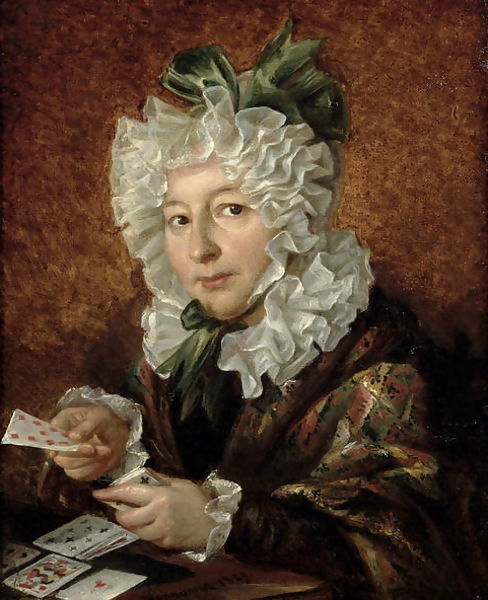
Walenty Wańkowicz’s Kobieta układająca pasjansa, usually translated as Woman Playing Solitaire or Woman Playing Patience, is consistently dated to 1829 in the online reference sources located during this research. The work depicts a seated woman in an elaborate white bonnet and ruff, holding playing cards while laying out a game of patience.
The painting belongs to a particularly important moment in Wańkowicz’s career. He had trained under Jan Rustem at the University of Vilnius before continuing his studies at the Imperial Academy of Arts in St Petersburg. In 1829, after receiving repeated academic distinctions, the Academy considered sending him to Italy on a scholarship; the journey ultimately did not take place. The same period produced some of his best-known portraits, including images connected with Adam Mickiewicz and Maria Szymanowska.
Wańkowicz is associated with the Vilnius school of painting and with the transition from late Classicism toward Romanticism. Portraiture formed the largest part of his output. In this picture, the sitter is presented not in a formal ceremonial pose but in a quiet domestic activity, giving the work an unusually intimate character within his portrait production.
The work is reproduced under the Polish title Kobieta układająca pasjansa in the Pinakoteka Zaścianek catalogue of Wańkowicz’s works, which gives the date 1829 but does not identify a present collection. It is also reproduced on Wikimedia Commons and appears in modern biographical accounts of the artist. English-language references commonly call it Woman Playing Solitaire.
No reliable record located in this research establishes the painting’s present owner or collection, dimensions, medium, provenance, or a modern auction history. These details therefore remain intentionally unfilled rather than inferred. The present whereabouts of the original painting are unconfirmed.
The Missing Canvas is seeking to identify the current location of this work and would welcome confidential contact from the owner, descendants of former owners, advisers, dealers, scholars, or anyone with documentary information that may help trace it.