Between biography and legend: the problem of Wańkowicz's chronology
Walenty Wańkowicz occupies an unusually complex place in the art history of nineteenth-century Vilnius, Minsk, St Petersburg and Paris. Even the basic chronology of his life illustrates the archival difficulties that surround him. Polish museum cataloguing generally gives his birth as 14 February 1799 at Kałużyce in the former Minsk Governorate, whereas Lithuanian scholarship often uses 25 May 1800; older publications introduce still other calendar formulations. The divergence is not merely a bibliographical curiosity. It is symptomatic of an artist whose biography was reconstructed from family memory, nineteenth-century reminiscence, academic records and collections dispersed across several modern states. Dalia Tarandaitė's substantial study in the Lithuanian Art Museum Yearbook remains particularly important because it confronts this fragmented record through contemporary testimony, including that of Wańkowicz's friend and fellow artist Wincenty Smokowski. The result is a figure more interesting than the simplified label of “Romantic painter”: a landed nobleman with sufficient private means to avoid total dependence on commissions, a technically rigorous pupil of Jan Rustem, a participant in the intellectual society surrounding Adam Mickiewicz, and later a painter whose religious and mystical convictions increasingly shaped both his private life and artistic choices.
Polotsk and Vilnius: drawing, literature and the formation of a portraitist
Wańkowicz's first systematic artistic education began at the Jesuit academy in Polotsk, where he developed a strong command of drawing before entering Vilnius University in 1818. Vilnius was decisive. Under Jan Rustem, and within the wider environment in which Jan Damel, engraving, theatre and exhibition culture intersected, Wańkowicz absorbed the disciplined construction of the figure expected of academic training while becoming increasingly attentive to the sitter's psychological presence. His education was broader than studio practice: the university exposed him to literature, languages, history and a social world in which artistic identity was inseparable from intellectual exchange. Tarandaitė notes his interest in lithography and his contact with Adam Mickiewicz and other members of the Philomath milieu; he was not himself a Philomath, but belonged to the related Filaret association. This context matters because portraiture in Wańkowicz's hands became something more than the recording of physiognomy or rank. The faces of friends, poets, officers and intellectuals became vehicles for character, vocation and inward states. The Lithuanian National Museum of Art characterises the Romantic conception of portraiture in his work precisely in these terms: moral value, thought and feeling mattered as much as outward appearance.
His earliest portraits of Mickiewicz already reveal this direction. Wańkowicz drew the poet repeatedly in Vilnius, sometimes in intimate formats far removed from the later monumental image of the inspired Romantic bard. Three early Mickiewicz drawings once in the Krasiński Library in Warsaw were destroyed in 1944, although reproductions and related variants preserve evidence of the group. This destruction is important for understanding why Wańkowicz's oeuvre can appear smaller and more repetitive than it originally was: familiar compositions often survive because they were copied or reproduced, while quieter drawings, miniatures and family works disappeared with private libraries and estates. The reconstruction of the artist's career therefore depends on treating prints, inscriptions, exhibition references and old photographs not as secondary curiosities but as evidence for a much larger body of work.
St Petersburg: academic distinction and the invention of the Romantic poet
From 1825 Wańkowicz continued his training at the Imperial Academy of Arts in St Petersburg on a Vilnius University scholarship. The Academy supplied a different scale of ambition. According to Lithuanian reference sources, he received successive distinctions for figure drawing and in 1827 a small gold medal for The Feat of a Young Kievan. Yet his most consequential achievement in St Petersburg was not an academic history painting but portraiture. In 1827–1828 he created the composition now generally known as Adam Mickiewicz on the Ayu-Dag Cliff, inspired by the Crimean Sonnets. Here the sitter is not merely recognisable; the entire setting participates in the construction of poetic identity. Mickiewicz's turned profile, striped trousers, fur mantle, distant mountains, unsettled sky and the lyre placed on the rock collectively transform the portrait into an emblem of Romantic authorship. Contemporary responses recorded by Tarandaitė emphasise both likeness and the sense that Wańkowicz had captured the poet's spirit. Mickiewicz himself reportedly considered it the most faithful of his portraits. Wańkowicz actively disseminated the image through lithography, helping to turn a painted likeness into a cultural icon.
The history of the Mickiewicz composition is, however, more complicated than a single canonical canvas. Repetitions, replicas, later copies and graphic versions circulated widely. The National Museum in Warsaw explicitly records that the prototype associated with Michał Borch is of unknown present location, while museum versions survive in Warsaw and Vilnius. This distinction is precisely the kind of provenance problem that matters to The Missing Canvas: identifying a painting as “Mickiewicz on the rock” is not enough; the material, dimensions, inscriptions, provenance and relationship to the known variants must be established. The same St Petersburg period produced the lost portrait of Alexander Pushkin, conceived as a pendant to Mickiewicz. A diary entry from March 1828 records both portraits in Wańkowicz's studio, while later testimony describes the Pushkin image as unfinished. The painting itself has not survived; a preparatory study is preserved in the Pushkin Museum in St Petersburg. Wańkowicz also painted the celebrated pianist Maria Szymanowska and designed imagery for music associated with Mickiewicz's Konrad Wallenrod. The interweaving of portrait, poetry and music is one of the most distinctive features of his mature formation.
Return to the former Grand Duchy: family, friendship and independence from the market
After returning from St Petersburg, Wańkowicz settled mainly at Malaya Slepanka near Minsk while maintaining close ties with Vilnius. His financial position as a landowner gave him a degree of freedom unusual among professional portraitists. Tarandaitė stresses that he did not have to pursue commissions with the same urgency as artists dependent on fees; he frequently painted relatives, friends and people whose intellectual or moral character interested him. This explains the extraordinary intimacy of many works from the 1830s. Family portraiture became especially important after his marriage to Aniela Rostocka. Contemporary correspondence noted the growing number of family pictures in the household, and later scholarship has shown that Aniela's features recur in works connected with the artist's domestic and religious imagery. A portrait of Aniela from a private Vilnius collection, newly clarified by Rūta Janonienė and sold at ARS VIA in 2024, is particularly valuable because it allows comparison between family likeness and other proposed works. The very existence of several family portraits in nineteenth-century family collections also demonstrates how much of Wańkowicz's output remained outside institutions for generations.
Vilnius remained central to his social and artistic world. He continued to meet artists such as Kanuty Rusiecki and Wincenty Smokowski and maintained relations with Ferdynand Gutt and Andrzej Towiański. The portrait of Towiański, now in the National Museum in Warsaw, belongs to a group in which Wańkowicz's interest in inward concentration becomes almost austere. By contrast, portraits such as that of Stanisław Chomiński possess military energy and social immediacy. Portraits of Antoni Gorecki, Kazimierz Piasecki, the Piasecki family, Wojciech Pusłowski and others demonstrate that his mature style was not a single formula but a flexible language adjusted to the perceived character of the sitter. Costume and setting can be meticulously described, but neither becomes merely decorative. The best portraits place the face, gesture and psychological relation among figures at the centre of the composition.
Romantic portraiture: likeness, mood and moral character
Wańkowicz's portrait style developed at the intersection of late Classicist discipline, Biedermeier attention to domestic detail and Romantic interest in exceptional individuality. His drawing is usually firm and controlled; heads are modelled with care, and the sitter's gaze is often used to imply a mental life extending beyond the picture. The palette tends toward warm browns, deep greens, reds and subdued neutral backgrounds, although works such as the Mickiewicz portrait employ landscape and colour more theatrically. This combination helps explain why attribution can be difficult. A generic dark-background portrait of the 1820s or 1830s is not automatically Wańkowicz, and the artist's name has sometimes been attached to competent portraits from the wider Vilnius–Minsk circle on stylistic grounds alone. Conversely, his own production encompassed oil painting, drawing, chalk, pastel, lithography and portrait miniatures, meaning that authentic works may not conform to the appearance most collectors associate with him.
Miniatures are especially significant. They connect his early training, his social network and his habit of creating intimate likenesses for private circulation. The 1835 Singers of Vilnius Cathedral in the National Museum in Warsaw is a rare genre-inflected example: two men bend toward an open music book while a candle illuminates the scene. The museum records the linked initials “WW” at lower left and an inscription on the reverse stating that Wańkowicz painted the singers from nature in Vilnius in 1835. For attribution studies this small work is disproportionately useful. It provides a secure signature form, a date, a place and an inscription tied to the artist's own lifetime. Such anchors are essential when assessing unsigned miniatures or portraits with old family attributions.
Mysticism, Towiański and the expansion of portrait into belief
Wańkowicz's relationship with Towiański should be treated as an historical factor rather than a romantic anecdote. Tarandaitė reconstructs a gradual intensification of the artist's interest in mysticism from the Vilnius years through St Petersburg and the 1830s. He read religious and theosophical writers, was close to Ferdynand Gutt, and ultimately accepted Towiański's spiritual mission. These convictions influenced both his social behaviour and his art. The painter's portraits of Towiański and his family belong to the visual history of a movement that would later become deeply entangled with Polish émigré culture in Paris. Religious paintings and copies after older masters formed an important parallel strand of his practice, alongside allegorical compositions described in written sources but now lost. None of this reduces Wańkowicz to a “mystic painter.” Rather, it helps explain why the idea of the sitter's moral and spiritual state became increasingly important in his portraiture.
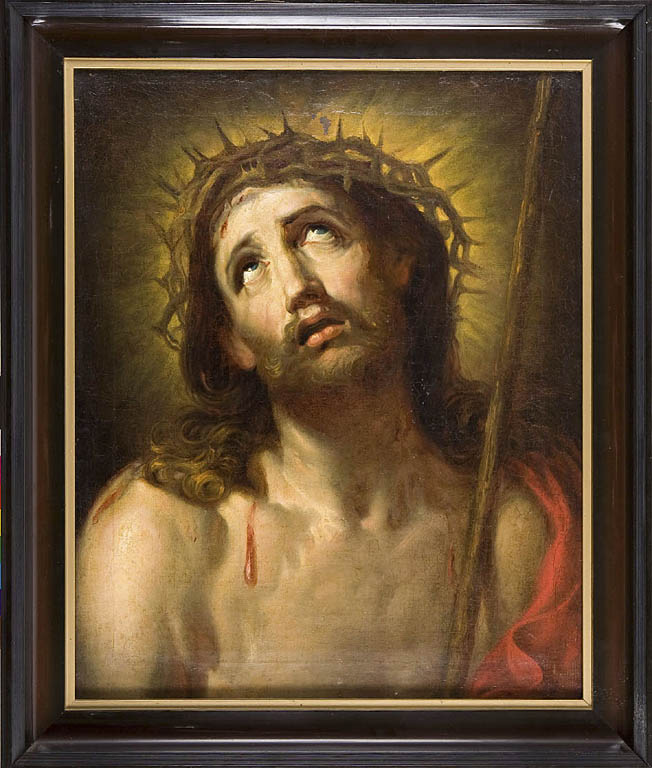
Tarandaitė’s 2002 study makes the Ecce Homo question more precise, and it is important not to collapse several different records into one painting. First, she notes that the literature records a Christ image sent by Wańkowicz to S. Stroganov; other biographical research places this episode in 1832, when the artist assisted Andrzej Towiański in an unsuccessful attempt to interest Sergei S. Stroganov in his spiritual mission. The surviving account does not identify the iconographic type of that picture. Separately, Wincenty Smokowski described an Ecce Homo by Wańkowicz with exceptional enthusiasm and recorded that the image was disseminated by lithography in St Petersburg and Lithuania. Tarandaitė does not identify the present location of that original. Finally, in Paris Wańkowicz painted another Ecce Homo from an engraving after Guido Reni supplied by Towiański. Tarandaitė stresses that this was not an exact copy: Wańkowicz retained Reni’s composition while introducing his own emotional understanding of Christ’s suffering. Crucially, her catalogue note records that the Paris painting survives in the Adam Mickiewicz Museum of Literature in Warsaw, oil on canvas, 92 × 71.5 cm; a related watercolour design for the Towiańskian banner also survives there. The 55.5 × 46 cm canvas offered at DESA Unicum in 2009 is therefore not the same object as that documented Paris painting. It is better described, at present, as a separate Reni-derived version attributed to Wańkowicz. Whether it relates to the earlier Ecce Homo described by Smokowski, to the Christ image sent to Stroganov, or represents another variant altogether remains unresolved and should be treated as a research question rather than a provenance claim.
Paris, the Gate of Dawn and the final year
Wańkowicz travelled west at the end of the 1830s, spending time in German artistic centres before reaching Paris in 1841. There he renewed contact with Mickiewicz and entered the émigré environment in which Towiański's ideas had acquired a new political and religious charge. His health was already fragile, and his final Parisian period was short. The copy of the Virgin of the Gate of Dawn for Saint-Séverin is among the most symbolically resonant works associated with these months because it transferred a sacred image of Vilnius into the devotional geography of exile. Wańkowicz died in Paris on 12 May 1842 and was buried at Montmartre. His testament was drawn up in the presence of Mickiewicz, a fitting if poignant end to a relationship that had begun in the intellectual world of Vilnius and produced one of Romanticism's most enduring portraits.
Signatures, inscriptions and attribution
Collectors searching for a Walenty Wańkowicz signature should resist the idea that there is one universal form. Secure museum works demonstrate several types of marking. Napoleon by the Fire carries the inscription “fecit Wańkowicz 1834” on the right side, while Singers of Vilnius Cathedral is signed with linked initials “WW” at lower left and supplemented by a detailed inscription on the reverse. The self-portrait in Warsaw contains a painted identifying inscription at upper right. These examples establish authentic letter forms and habits, but they do not justify rejecting an unsigned work: many portraits were made within family and friendship networks and were not conceived for an anonymous market. Nor does an old inscription on a stretcher by itself prove authorship. The 2019 DESA sale of a Portrait of Mrs Dohtonowicz, for example, was catalogued as unsigned but carried a later pencil attribution on the stretcher. For serious attribution, signature evidence must be weighed together with support, ground, handling, costume chronology, provenance, historical photographs and comparison with securely documented works.
Documented signature anchors: “fecit Wańkowicz 1834” on Napoleon by the Fire; linked “WW” on the 1835 Singers of Vilnius Cathedral; identifying inscription on the Warsaw self-portrait. High-resolution photographs of signatures, reverse inscriptions, labels and old frames are particularly useful when evaluating privately held works.
Private collections, confiscation and the dispersal of the oeuvre
The survival history of Wańkowicz's art is inseparable from political upheaval and family dispersal. His drawings, albums, portraits and personal collection were preserved for a time at Malaya Slepanka by his widow Aniela and later inherited with the estate by their eldest son Adam. After Adam's participation in the 1863 uprising he was arrested and exiled to Siberia, and the estate was confiscated. Tarandaitė records that the Wańkowicz works and the painting collection once at Malaya Slepanka did not survive; material that escaped the confiscation was subsequently lost during the Second World War. Elsewhere, works remained with relatives and friends and migrated into collections in Vilnius, Warsaw, Kraków, St Petersburg, Paris, Turin and private hands. This dispersed pattern is fundamental to any modern catalogue raisonné. It also means that a painting emerging from an old family collection is not an anomaly but exactly the sort of provenance history one would expect for Wańkowicz.
One of the most valuable archival clues is the material assembled in the early twentieth century by the artist's descendant Stanisław Dangel. Tarandaitė notes that Dangel described many works that no longer survive and are not known from other sources, and explicitly observed that further Wańkowicz works might still be identified in Lithuania, Poland or Paris. That conclusion remains relevant. New research on Aniela Wańkowicz's portrait, published by Rūta Janonienė and later brought to the market, demonstrates that the oeuvre is not closed. Private ownership, family attribution and modern scholarship continue to intersect.
Unlocated Works and Open Questions
The category “missing” must be used carefully. Some Wańkowicz works are documented as destroyed; others are known only from literature; still others were sold publicly and simply have no published current location. The distinctions below are intentional.
| Work or group | Historical evidence | Research status | Why it matters |
|---|
| Portrait of Alexander Pushkin, c. 1828 | Contemporary testimony records the portrait in Wańkowicz's St Petersburg studio. Wincenty Smokowski stated that it remained unfinished; later sources record that the canvas passed to the artist's son and disappeared after the post-1863 confiscation of the family estate. A preparatory sketch is recorded in the Pushkin Museum in St Petersburg. | Lost / not surviving | Conceived in the same St Petersburg moment as the Mickiewicz portrait and one of the best-documented major losses from Wańkowicz's oeuvre. |
| Prototype / early version of Adam Mickiewicz on the Ayu-Dag Cliff | The National Museum in Warsaw records a prototype formerly owned by Michał Borch and explicitly gives its present place of preservation as unknown. | Present location unknown | Distinguishing the prototype from Wańkowicz's own replicas and later copies remains a central catalogue problem. |
| Woman Playing Solitaire, 1829 | Reproduced in modern reference sources, but no reliable present collection, dimensions, provenance or modern auction trail has yet been established in the sources located by The Missing Canvas. | Present whereabouts unconfirmed | An unusually intimate domestic subject from the year Wańkowicz returned from St Petersburg. |
| Portrait of a Lady Reading, 1839 | Signed and dated oil, 35 × 28 cm; documented at Sotheby's London, 22 February 1995, lot 40. | Present whereabouts unconfirmed | A securely documented late portrait whose published trail currently ends with the 1995 sale. |
| Christ Crowned with Thorns (Ecce Homo), attributed to Wańkowicz, 55.5 × 46 cm | Offered at DESA Unicum, Warsaw, 16 April 2009, lot 71, as “Walenty Wańkowicz (?)”; the reverse bears the handwritten inscription “F. Walanty Wańkowicz”. The composition is after Guido Reni. Tarandaitė's research confirms that Wańkowicz painted more than one Christ / Ecce Homo image, but the Paris Reni-derived painting she catalogued survives in Warsaw and measures 92 × 71.5 cm, so it is not this auction canvas. | Present whereabouts unknown · actively sought | The Missing Canvas is seeking this exact painting. Its possible relationship to the earlier unlocated Ecce Homo described by Smokowski remains an open attribution and provenance question. |
| Portraits associated with the Skirmant family | Family and historical literature records a number of Wańkowicz portraits within the artist's extended kinship and landed-patronage network. Their individual identities and subsequent histories require work-by-work verification. | Locations and identifications unresolved | This group should be treated as a provenance-research problem rather than as a single set of definitively lost paintings. |
| Other portraits of the Pusłowski family | Wojciech Pusłowski's portrait survives in the Lithuanian National Museum of Art. Historical literature also records portraits of his wife and sons; at least one Pusłowski portrait was reported destroyed during the Second World War, while the fate of the remaining family portraits is not fully resolved. | Mixed: surviving, destroyed and unresolved | Separating the surviving museum portrait from the wider historical family group prevents the entire commission from being incorrectly classified as lost. |
| Additional family portraits of Aniela Wańkowicz and the children | Contemporary correspondence and later family records indicate that Wańkowicz painted his wife and children repeatedly. A 1833 family portrait survives in the National Museum in Warsaw, but several other family compositions mentioned in the sources are no longer securely traceable. | Partly surviving; further works unlocated | These works are important for both family provenance and attribution, since Aniela's likeness recurs in Wańkowicz's domestic and religious imagery. |
| Religious and allegorical compositions known from written sources | Nineteenth-century accounts mention a number of religious, Napoleonic and family-allegorical compositions beyond the securely identified surviving paintings. | Work-by-work status unresolved | These references should not automatically be labelled “lost”: some may survive under altered titles, uncertain attributions or in private collections. |
Walenty Wańkowicz on the art market: provenance, scarcity and evaluation
Wańkowicz appears on the market infrequently enough that individual transactions should not be turned into a simplistic price guide. Quality, attribution, sitter, condition, documentation and provenance can alter value dramatically. The re-emergence of documented works in recent years is nevertheless significant because it shows that paintings long preserved in private ownership can still return to scholarly and market attention. For Wańkowicz in particular, the strength of documentary evidence often matters as much as the name attached to the work: a secure sitter identification, old family provenance, inscriptions, exhibition history and comparison with museum pictures can substantially change how a painting should be understood and evaluated.
For owners considering the sale of a Walenty Wańkowicz painting, drawing or miniature, early documentation can be as important as the image itself. Family inventories, inscriptions, photographs, correspondence, seals, labels and records of former estates may transform an uncertain attribution into a researchable provenance. The Missing Canvas is particularly interested in works connected with Vilnius, Minsk, the artist's family and intellectual circle, and works whose present location has fallen out of the published record.
Why Wańkowicz matters
Wańkowicz's importance lies not simply in having painted a famous portrait of Mickiewicz. He gave visual form to a cultural network stretching from Vilnius to St Petersburg and from the estates around Minsk to the émigré world of Paris. His best portraits combine academic discipline with a Romantic conviction that a likeness should reveal vocation, moral temperament and inward life. He was equally at home in monumental oil portraiture and tiny, intimate miniatures; he moved between family affection, public reputation, national memory and religious belief. The losses suffered by his oeuvre through confiscation, war and dispersal make the surviving works all the more important, but they also leave the field open. The catalogue is not complete. Paintings documented in nineteenth- and early twentieth-century collections may still survive under old family names, uncertain attributions or simply outside scholarly view. Recovering those works can change not only the market record of Wańkowicz but the art history of the Vilnius school itself.


Comments and research notes
Share what you know
If you recognise a Wańkowicz portrait, old collection, signature, exhibition reference or archival photograph, you can add a research note.
Loading comments…
Public comments are user submissions and do not represent the position of The Missing Canvas. Incorrect, abusive or inappropriate submissions may be removed.