Born25 November 1821 · Vilnius
Died12 November 1876 · Vilnius
TrainingVilnius · St Petersburg · Italy
Primary fieldLandscape painting
Names, Dates and a Biography Still Being Refined
The artist appears in different languages and cataloguing traditions as Albert Żamett, Albert Zamett, Albertas Žametas, Albert Aleksander Żamett and, in some Polish art-market sources, Albert (Wojciech) Żamett. The spelling variation is not trivial for provenance research: a nineteenth-century label, catalogue or auction database may index the same artist under a different form of the surname.
Archival research published by art historian Rūta Janonienė gives a precise death date of 12 November 1876 in Vilnius, based on the records of the city's Evangelical Lutheran community. Some older market databases still use 1877, but the archival evidence supports 1876. Żamett was born in Vilnius on 25 November 1821 and grew up in a bourgeois Lutheran family. His father Daniel had come to Vilnius from Prussia; through his mother's Zeidler family connections, the young artist belonged to a social circle that also intersected with the family of Jan Rustem.
Żamett lost his father early and, as the eldest son of a large family, carried practical responsibilities alongside his artistic ambitions. This background makes the patronage that later enabled his European career especially important.
Early Artistic Training in Vilnius
Żamett received his first substantial artistic education in Vilnius. Janonienė records instruction from Mateusz Przybylski at the gymnasium and from Kanuty Rusiecki at the Institute for the Nobility; private contact with Michał Kulesza is also possible. This placed him within the generation formed after the closure of Vilnius University, when the traditions of the earlier Vilnius School survived through individual teachers, private instruction and local artistic networks rather than through a single university department.
Landscape quickly became his principal field. Even before his mature Roman period, Żamett showed a strong interest in trees, cloud formations, spatial depth and changes of light. A surviving study album contains thirty-eight sheets of landscape fragments, figures, buildings, animals and atmospheric studies from his student years. These drawings are particularly valuable because they reveal the discipline behind the finished paintings: close observation of nature rather than formulaic invention.
St Petersburg and Maxim Vorobiev
From 1841 to 1847 Żamett studied as a free auditor at the Imperial Academy of Arts in St Petersburg in the landscape class of Maxim Vorobiev. Vorobiev's teaching was important for a generation of landscape painters in the Russian Empire. It combined academic construction of space with an interest in emotional atmosphere, light and the expressive possibilities of sky and weather.
Żamett's early album shows this training clearly. Studies made around Pargolovo, where Vorobiev had a villa and took students for summer practice, examine individual trees, parks, clouded skies and the relationship between shaded foreground masses and luminous distances. A compositional device already visible in an 1844 park drawing—dark vegetation opening toward a bright, distant view—would remain characteristic of many later landscapes.
Jan Kazimierz Wilczyński, the Album of Vilnius and the Tyszkiewicz Patrons
While Żamett was still a student, Jan Kazimierz Wilczyński recognised his talent and commissioned designs for the ambitious Album of Vilnius. Views after Żamett include Verkiai, Raudondvaris, Tuskulėnai, Ribiškės and Vingis. Contemporary writers praised these compositions for their picturesque grouping of trees, clarity of atmosphere and ability to give individual places a distinct emotional character.
Wilczyński was also instrumental in bringing the young painter to the attention of the Tyszkiewicz family. In 1846 Benedykt Tyszkiewicz paid substantial debts of the Żamett family and later financed the painter's journey to Italy. What had initially been conceived as a much shorter period abroad expanded into roughly twelve years of travel and study. The relationship became one of the decisive patronage connections of Żamett's life.
Italy, Rome and the Formation of His Mature Landscape Style
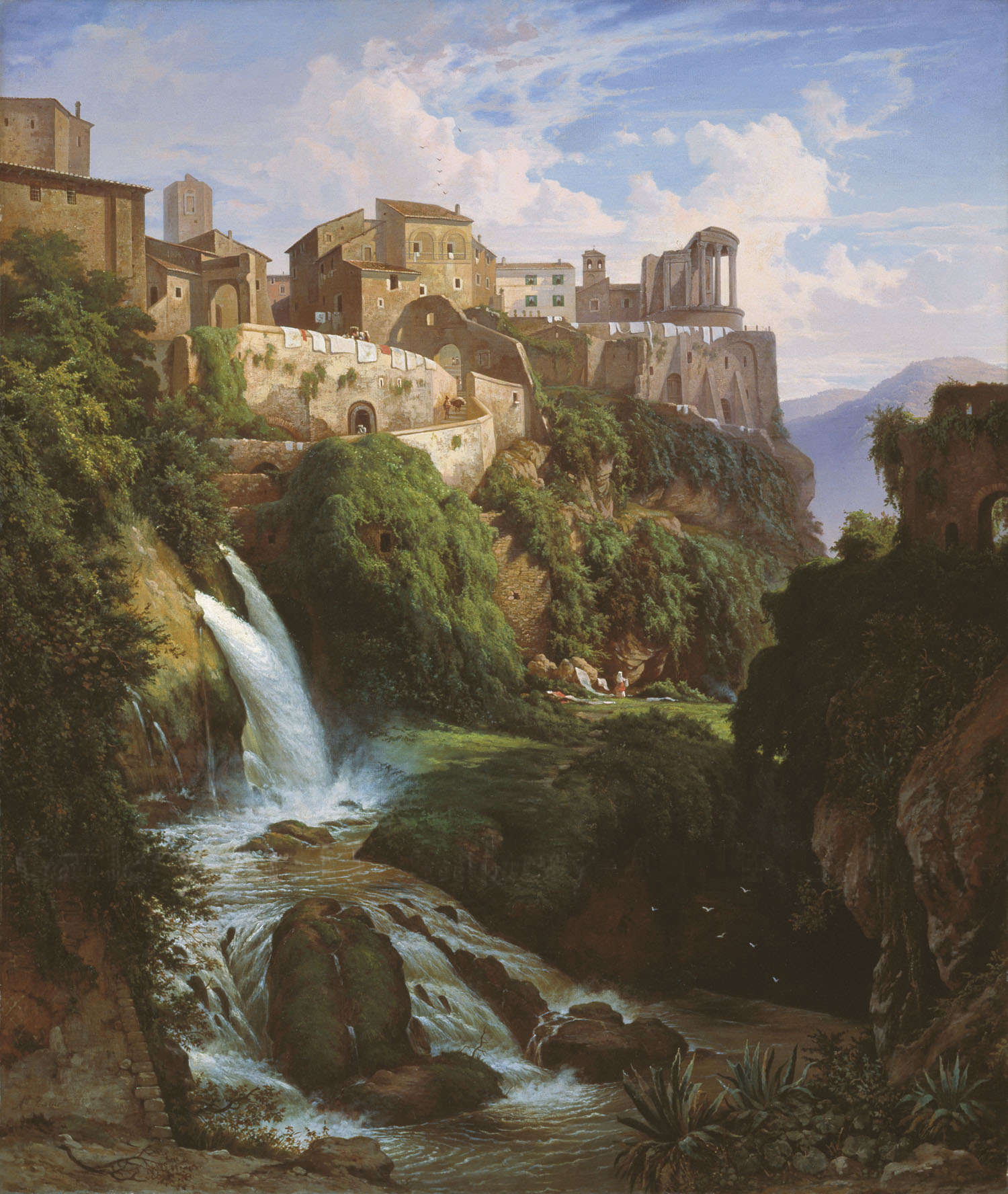
Italy transformed Żamett's career. He spent years studying the Roman Campagna, Tivoli, Albano and other sites, while also travelling in France, England, Germany and elsewhere. His drawings reveal additional journeys to Malta, Trouville and Marienburg. In 1853 the St Petersburg Academy granted him the rank of non-class artist for a view of the cascades at Tivoli; in 1859 he received the title of Academician for three landscapes of Rome and its surroundings.
Żamett's correspondence makes clear that he deliberately concentrated on direct study from nature. In a letter from Rome in 1851 he explained that, following the advice of good artists, he was making drawings and painted studies from nature rather than rushing into finished compositions. The surviving paintings justify that approach. His best Italian landscapes are built around air, atmosphere and measured transitions of light, not simply around picturesque architecture.
Nineteenth-century observers repeatedly emphasised serenity, harmony, colour and the convincing representation of atmosphere in these works. Józef Ignacy Kraszewski, visiting Żamett's Roman studio in 1858, remembered numerous warm, luminous studies of Italian nature as well as finished landscapes. Żamett continued to use his Italian studies after returning to Vilnius, producing new compositions from memories and material gathered abroad.
Landscape, Light and the Structure of Space
The recognisable qualities of Żamett's mature landscapes are not reducible to a single formula. Many works use a carefully articulated sequence of planes: a darker foreground of trees, rocks or architecture; a middle distance opened by water or a road; and luminous hills, sky or distant buildings. The movement of light across these planes creates both depth and mood.
His Italian subjects often combine architecture with nature so closely that ruins, villas, towers and churches function as part of the landscape rather than as isolated monuments. In Lithuanian subjects the same discipline serves a different emotional register. Views of Vingis, Verkiai and Trakai often carry a quieter, more elegiac character, in which historical architecture appears within a broad natural setting.
This combination of topographical precision and atmospheric idealisation is central to Żamett's importance. He belongs simultaneously to the Vilnius landscape tradition, the academic culture of St Petersburg and the international nineteenth-century practice of artists studying Italy.
Return to Vilnius: Museum, Cathedral and Cultural Life
Żamett returned to Vilnius in the autumn of 1858. He became actively involved with Eustachy Tyszkiewicz, the Vilnius Archaeological Commission and the Museum of Antiquities. In 1860 and again in 1861–1863 he travelled in Europe with Michał Tyszkiewicz, advising him on paintings for a private gallery intended to contribute to a future public art collection in Vilnius.
His work in the city went far beyond easel painting. He supervised the reconstruction of the Chapel of St Wladislaus in Vilnius Cathedral in 1862–1863, painted a fresco of Jerusalem and Golgotha in another cathedral chapel in 1865, and decorated the sacristy vault. Contemporary press also records a mural of Békés Hill painted in 1862 for Spohr's confectionery on Vokiečių Street. A surviving drawing of Békés Hill may relate to that lost interior decoration.
The Theatre Designer
From around 1859 Żamett designed scenery for the Vilnius theatre and from 1864 worked there regularly as decorator. Landscape training transferred naturally to the stage: architectural perspective, recession into depth, dramatic sky and controlled illumination were all central to theatrical scenery. Audiences and critics noticed his contribution. At the 1859 Vilnius production of Auber's La muette de Portici, the audience reportedly called the young painter before the curtain and applauded his scenery.
His designs for productions included views of Naples, Portici and Vesuvius; for Edward Odyniec's Barbara Radziwiłł he created a historical view of Vilnius with the cathedral and the Upper and Lower Castles. Only a very small part of this theatrical work survives. A rare watercolour stage-design project in the Wroblewski Library, showing a Rococo palace interior, is therefore an exceptionally important document of this less familiar part of his career.
Trakai: One Motif, Several Versions
Żamett's treatment of Trakai is one of the clearest demonstrations that his catalogue remains incomplete. A major 1847 watercolour of the ruins of Trakai Island Castle survives in the Lithuanian Academy of Sciences. Its nearly monochrome palette, calm water and warm evening light make it one of the most accomplished nineteenth-century images of the site.
Archival evidence, however, shows that this was not his only Trakai composition. In 1848 a landscape of the castle ruins in Wilczyński's collection, valued at forty silver roubles and described as painted à la Aivazovsky, was sent to Kyiv for sale. The Raudondvaris inventories also record a view of Trakai Castle among Żamett's oils; a gilded frame was made for it in 1861. A Ukrainian exhibition in 1857 included a moonlit view in which the reflection of the moon stretched across the lake. In 1860 a visitor to Żamett's Vilnius studio described yet another Trakai landscape in evening light, praising the treatment of the clouds.
These records may not all refer to distinct paintings, but together they prove that Żamett returned to Trakai repeatedly and varied the motif through changes of time, light and medium. Matching the surviving works to the historical descriptions remains an important problem for a future catalogue raisonné.
Private Collections and the Dispersal of Żamett's Oeuvre
Private ownership is fundamental to understanding Żamett. His Italian landscapes were bought enthusiastically by English visitors and other travellers, and the artist's long relationship with the Tyszkiewicz family placed a substantial group of his paintings in private aristocratic collections. As a result, an important part of his production left Vilnius almost immediately after it was painted.
One particularly valuable surviving work is the 1847 watercolour Vilnius Surroundings: Vingis, documented by Janonienė in a private collection in Vilnius. It can be compared with the lithographic version made for the Album of Vilnius and demonstrates the delicacy of Żamett's original watercolour technique more clearly than the printed reproduction.
The international dispersal of the Roman works is equally significant. Some are now in the Tretyakov Gallery, the National Museum in Kraków, the National Museum in Warsaw and other public collections, but many others passed through private ownership in Russia and Western Europe. Their modern histories are often poorly published.
The Tyszkiewicz Collection at Raudondvaris
The 1864 inventory of the Tyszkiewicz palace at Raudondvaris is one of the most important historical sources for Żamett's oeuvre. It records numerous Italian landscapes, including Roman aqueducts on the road to Albano, a view of Tivoli, Castel Gandolfo by Lake Albano, a tower in Italy, St Peter's in Rome, two versions of the Sabine Mountains, Rocca di Papa and other landscapes. The collection also contained a view of Trakai Castle, Kościuszko's house, a view of Pažaislis and two landscapes of Raudondvaris.
Not every item in this inventory should be labelled “lost”. Some compositions can be associated with paintings that later entered museums, and repeated motifs complicate identification. But the inventory provides a benchmark against which modern museum and auction records can be tested. Which of the Raudondvaris paintings can be securely identified today? Which left the family through inheritance or sale? Which may still survive under shortened titles or incomplete provenance? These are concrete provenance questions rather than abstract speculation.
Historically Documented Works Whose Location Is Unclear
Several Żamett works are known through photographs or catalogues rather than through a currently identified original. Janonienė notes that the original drawing for the celebrated Archaeological Hall of the Vilnius Museum of Antiquities is missing, although the Paris lithograph after it survives and allows the composition to be studied.
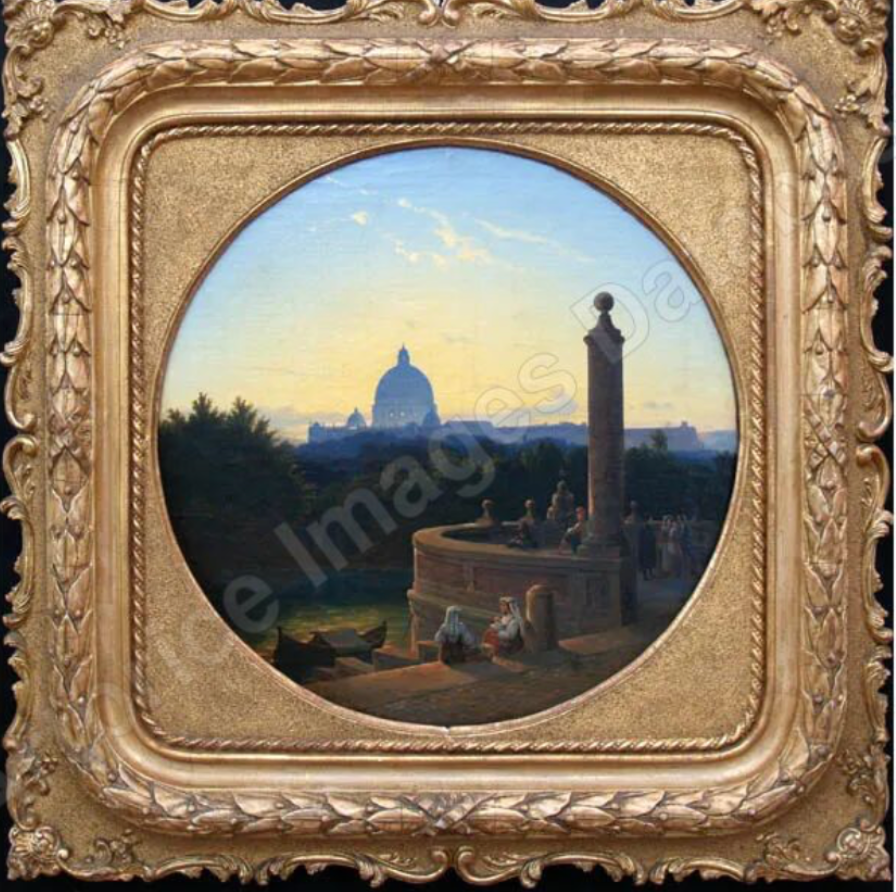
An especially intriguing record appears in the catalogue of the Second Painting Exhibition in Dorpat (Tartu) in 1871. Entry 160 lists Albert Zamett's View of St Peter's in Rome, described as having a glowing evening illumination and as being in the possession of Mrs General von Helmersen. The present location of the painting has not been established. Because Żamett painted Roman motifs repeatedly, it should not automatically be equated with another St Peter's view unless measurements, composition and provenance can be matched.
The Missing Canvas is separately seeking Veduta della Cupola di San Pietro dall'Antico Porto di Ripetta, dated 1842, last sold at CaputMundi in Rome on 27 October 2014 as lot 66. It is an oil on canvas measuring 46.5 × 46.2 cm and was recorded as signed, dated and located “Roma”. Its present whereabouts are unknown.
Unlocated and Unresolved Works by Albert Żamett
| Work or group | Historical record | Present research status |
|---|
| View of St Peter's in Rome | Dorpat Second Painting Exhibition, 1871, no. 160; “glowing evening illumination”; owned by Mrs General von Helmersen | Present location not established; should not be conflated with other Roman views without further evidence |
| Original drawing for Archaeological Hall of the Vilnius Museum of Antiquities | Composition lithographed in Paris in 1863 | Original drawing recorded as missing; lithographic versions survive |
| Trakai Castle in moonlight | Exhibited in Ukraine in 1857; praised for the moonlight reflected on the lake | Present location not securely identified |
| Trakai Castle in evening light | Seen in Żamett's Vilnius studio and described in the press in 1860 | May represent a distinct version; present location unresolved |
| View of Trakai Castle, Raudondvaris | Tyszkiewicz collection; gilded frame made in 1861 | Relationship to other documented Trakai versions requires clarification |
| Veduta della Cupola di San Pietro dall'Antico Porto di Ripetta, 1842 | CaputMundi Casa d'Aste, Rome, 27 Oct. 2014, lot 66 | Present whereabouts unknown; actively sought by The Missing Canvas |
“Unlocated” means that a present location has not been established in the sources consulted for this page. It does not imply that the work was destroyed, looted or lost during wartime.
Signatures and the Attribution of an Albert Żamett Painting
Żamett's signatures vary substantially. The 1847 Trakai watercolour is signed “Albert Zamett 1847”. The watercolour Vilnius Surroundings: Vingis carries a form transcribed as “Albert Ƶamett 1847”. An 1847 figure watercolour sold by DESA Unicum was signed and dated “A. Żammet w Warszawie | 1847”, while the 1861 Italian Landscape: Monte Sore in Abruzzo was signed “A. Żamet | Paryż 1861”. The Roman work last sold in 2014 was described as signed, dated and located “Roma”.
This spelling instability is one reason signature comparison must be contextual rather than mechanical. Authenticity should be assessed through the support, ground, paint handling, construction of perspective, cloud and foliage studies, provenance and documentary history together with handwriting. A signature that differs slightly from a familiar market example is not by itself evidence against attribution.
One useful historical comparison is a sepia view of the courtyard of Verkiai Palace attributed to Żamett and known from an old photograph formerly in the collection of Baron Dangl. Because the original is not presently available for examination, it is best treated as comparative documentation for attribution rather than as a secure benchmark on its own.
For landscape works, the relationship between shaded foreground masses and luminous distance, the organisation of planes, the treatment of atmospheric perspective and the integration of architecture with nature are particularly useful comparative features. Works on paper require separate comparison with the early study album and the refined watercolours connected with the Album of Vilnius.
Albert Żamett on the Art Market: Prices and Sale Records
Żamett appears relatively infrequently at international auction, and prices vary sharply according to medium, quality, subject and provenance. One of the strongest public results is the 1861 oil Italian Landscape: Monte Sore in Abruzzo, 77 × 105.5 cm, signed “A. Żamet | Paryż 1861”. It sold at Agra-Art in Warsaw on 21 March 2010 for 63,000 PLN; MutualArt reports the result as approximately USD 21,900 and identifies it as the artist's auction record in its database.
Works on paper occupy a different market level. DESA Unicum offered the 1847 watercolour Italian Mandolin Player, 31.5 × 22.2 cm, in 2013 with an estimate of 8,000–10,000 PLN and a starting price of 6,000 PLN. The Roman view now sought by The Missing Canvas sold in Rome in 2014 for a hammer price of €2,250.
These are historical auction records, not current valuations. The price of an Albert Żamett painting depends on quality, date, subject, scale, condition, signature, provenance, exhibition history and whether the work belongs to a particularly important group such as Vilnius, Trakai or the mature Italian landscapes.
Accordingly, the price, sale history and signature of an Albert Żamett painting should always be considered in relation to the individual object rather than a generic artist average. A well-documented view of Vilnius or Trakai, or a mature Italian landscape with strong provenance, can have a very different scholarly and market significance from a small, more generic study. Documentary history, date, subject and quality are particularly important in an oeuvre that remains only partially reconstructed.
Why Żamett Matters
Żamett's significance lies in the breadth of the cultural world his work connects. He was trained in Vilnius and St Petersburg, matured through long study in Italy, worked for one of the great visual publishing projects of nineteenth-century Vilnius, enjoyed Tyszkiewicz patronage, participated in the Archaeological Commission and Museum of Antiquities, contributed to the decoration of Vilnius Cathedral and became a major theatre designer.
His paintings also preserve a particular nineteenth-century understanding of place. In his Lithuanian landscapes, historical architecture and local memory are embedded in atmosphere and topography. In Italy, the same sensitivity to light and air gave familiar monuments a distinctive calm and spatial clarity. The surviving works demonstrate a painter of much greater range than the simplified label “Italian landscape painter” suggests.
The fact that no complete catalogue of his oeuvre yet exists is therefore not merely a bibliographical inconvenience. It means that private collections, historical inventories, photographs and auction archives may still materially change our understanding of one of the most important landscape painters associated with nineteenth-century Vilnius.
Comments & research notes
Share what you know
If you recognise a Żamett landscape, historical collection, exhibition reference or archival photograph, you are welcome to contribute a research note.
Loading comments…
Public comments are contributions from visitors and do not represent The Missing Canvas. Inaccurate, abusive or inappropriate comments may be removed.