Primary fieldLandscape painting
TrainingVilnius / Warsaw · St Petersburg
European centresDüsseldorf · Paris · Rome
Research statusOeuvre dispersed and incomplete
An Unusually Unstable Biography
Even the basic dates of Józef Marszewski's life require caution. A large part of twentieth-century and current reference literature gives a birth around 1825 and death in Warsaw in 1883. The Musée d'Orsay documentation database, older Polish exhibition literature and many auction catalogues repeat variants of this chronology. Other evidence, however, points strongly toward a different biography.
Wojciech Gerson, who knew Marszewski personally and wrote about him in 1891, associated the artist with Vilnius and gave an 1827 birth. More recent Lithuanian research has drawn attention to parish records for Juozapas Kazimieras Marševskis and to documentation of the painter's death in Vilnius in March 1874. The historic grave monument also bore the dates 1827–1874, and Lithuanian cultural-heritage documentation identifies the painter accordingly.
For a scholarly account, it is therefore better to preserve the disagreement rather than silently select one traditional chronology. The Missing Canvas uses 1827–1874 as the best-supported archival sequence while retaining 1825–1883 in the text and metadata because that form remains widespread in museum, auction and bibliographic records. This discrepancy is not a minor editorial detail: it affects the dating of late paintings, exhibition histories and even the interpretation of the well-known photographic portrait traditionally dated 1875.
Vilnius, Early Training and the Landscape Tradition
Marszewski's earliest artistic formation is also described differently by the sources. He is said to have studied either with Aleksander Kokular in Warsaw or with Wincenty Dmochowski in Vilnius, and it is entirely possible that he encountered both environments. The Vilnius connection is especially important. Dmochowski was one of the leading landscape painters to emerge from the artistic culture created around Vilnius University, and Marszewski's later work shares the regional concern with topography, architectural memory and landscape as a carrier of historical identity.
What separates Marszewski from a purely local tradition is the breadth of his subsequent education. Between 1853 and 1856 he studied landscape painting at the Imperial Academy of Arts in St Petersburg under the circle of Maksim Vorobyov. Academy records and later biographies note silver medals awarded for landscape compositions, including a view of the Neva during the breaking of the ice and a view of Revel. The training reinforced precise drawing, spatial construction and an ability to render weather and atmospheric effects.
Marszewski also moved among artists who would become important figures in Russian landscape painting. His association with Ivan Shishkin is recorded in later recollections. Such contacts place him within a broader transnational network rather than within a narrowly defined national school.
Düsseldorf, Paris, Italy and the European Landscape
After St Petersburg, Marszewski travelled extensively. His itinerary included Paris, Spain, Switzerland, Italy and Germany. In Düsseldorf he worked in the orbit of Andreas Achenbach, one of Europe's most influential landscape painters. The Düsseldorf school offered a model in which observed nature could be transformed through dramatic composition, carefully directed light and a heightened sense of atmosphere.
Italy became equally important. Marszewski painted Mediterranean coasts, harbours and idealised southern landscapes, often in relatively intimate formats. Surviving works show softer tonal transitions and a warmer palette than many of the northern landscapes. A signed Italian Landscape dated 1866 is preserved by TARTLE, while Fishermen's Boats in France of 1869 and a Mediterranean Region dated 1870 have been documented in private Lithuanian collections.
His travels were not simply episodes of artistic tourism. They broadened the visual vocabulary he later applied to Lithuania. The warm light sometimes noted in his Vilnius landscapes may reflect the experience of southern painting, while his training in Düsseldorf reinforced the dramatic organisation of skies, ruins, water and distant horizons.
The Painter of Vilnius and Its Surroundings
Marszewski's most culturally significant landscapes are arguably those devoted to Vilnius and the surrounding region. He painted Gediminas Hill, the Bernardine Garden, suburban districts, the valleys of the Vilnia and Neris, roads leaving the city and broad panoramas seen from elevated viewpoints. These compositions have documentary value because they preserve elements of nineteenth-century topography, but their importance is not merely descriptive.
In Marszewski's hands, Vilnius becomes a landscape rather than simply an architectural view. Roads, slopes, vegetation and rivers often occupy as much attention as churches or urban monuments. Small figures introduce the rhythms of ordinary life. The city is viewed from its edges, as if culture and nature were inseparable parts of the same environment.
This duality helps explain why his landscapes are often described as both Romantic and realist. The sites are recognisable and frequently precise, yet their emotional effect depends on light: evening glow, mist, moonlight, reflected sky and the contrast between illuminated distance and darker foreground. Nocturnal Landscape with Windmills, painted in Düsseldorf in 1864 and now in the National Museum in Warsaw, is one of the clearest examples of his interest in nocturnal atmosphere.
Trakai: A Motif, a Museum Painting and an Unlocated Work
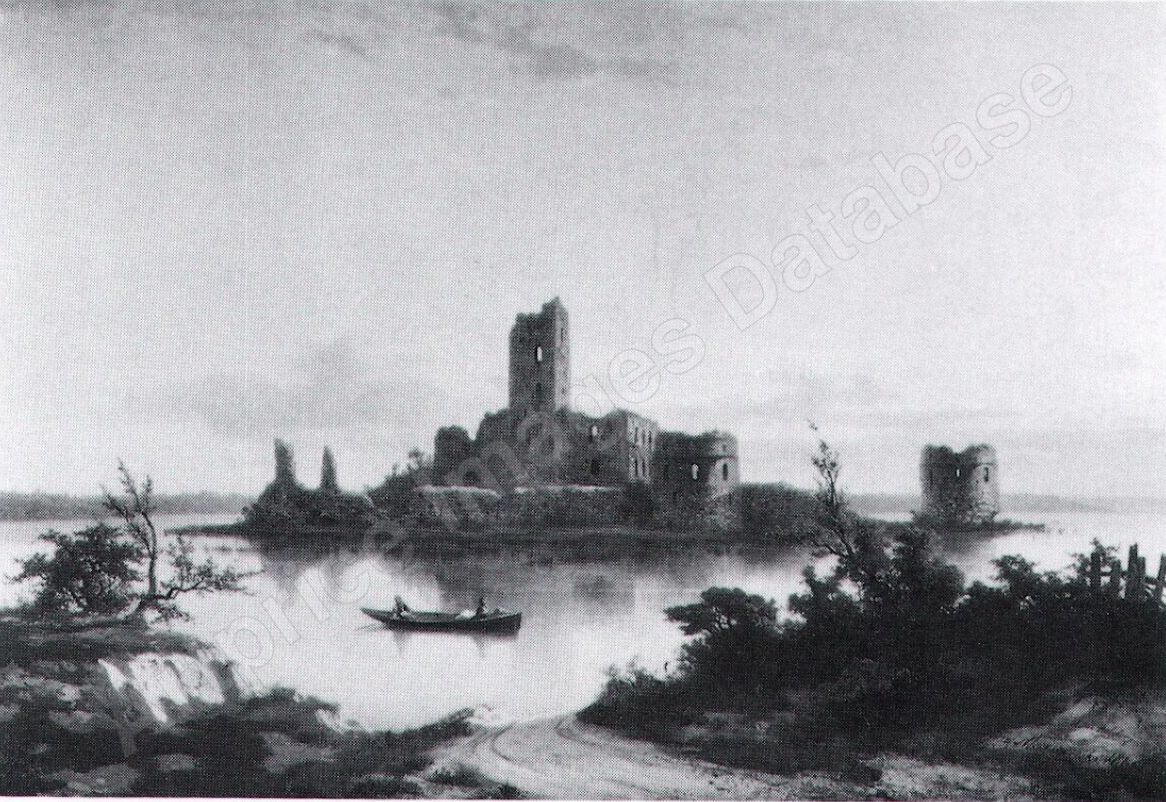
Trakai occupies a special position in Marszewski's oeuvre. The ruins of the island castle allowed him to combine topographical specificity with a quintessentially Romantic subject: architecture marked by time, isolated within a broad expanse of water and transformed by evening light.
It is important, however, not to confuse two different works. The National Museum in Warsaw preserves the large Ruins of the Trakai Island Castle at Sunset, dated 1866, measuring approximately 80 × 119 cm. A second composition, sold much later under the German auction title Burgruine auf einer Insel, was offered at Dorotheum in Vienna on 13 September 1995, lot 723. The Missing Canvas identifies that work as another View of Trakai. Its present whereabouts have not been established.
Private Collections and the Dispersal of Marszewski's Work
Marszewski is particularly relevant to provenance research because a meaningful part of his work has remained outside public museums. Historical Warsaw catalogues noted that many of his paintings were found in manor houses and palaces in the Ukrainian territories where he stayed for extended periods. A 1925 catalogue of the Society for the Encouragement of Fine Arts in Warsaw specifically recalled his residence at Wołodarka with Leopold Abramowicz and the presence of numerous works in local estates.
This pattern continues in modern collections. Fishermen's Boats in France of 1869 has been published from the Ellex Valiunas collection. A Mediterranean Region of 1870 is documented in the collection of Dr Jaunius Gumbis. TARTLE preserves an Italian Landscape of 1866. These works demonstrate that Marszewski's corpus cannot be reconstructed from national museum collections alone.
Private provenance is especially important for smaller landscapes. Such paintings were portable, attractive to travellers and collectors, and easy to transfer through inheritance. A work may remain in the same family for generations while disappearing entirely from exhibition literature. Conversely, a painting can re-enter public view through an auction with little surviving knowledge of the earlier ownership.
Lost, Unlocated and Historically Recorded Works
Several categories of Marszewski's production are known primarily through written sources. Literature records portraits, religious subjects and an early battle painting, Passage Across the Berezina, dated to 1847, but these categories are absent from the familiar museum corpus of landscapes. Their disappearance from current view is one of the clearest indications that the surviving oeuvre is incomplete.
Historical exhibition records open further lines of enquiry. The 1864 report of the Kraków Society of Friends of Fine Arts lists Marszewski's Ruins of Trakai Castle. A wood engraving published in 1869 reproduced another painting by him, the ruins of the castle at Chupków/Hupków, then exhibited by the Warsaw Society for the Encouragement of Fine Arts. Such reproductions can preserve the composition of a painting even when the object itself is no longer readily traceable.
The pre-war collection of the Warsaw Society for the Encouragement of Fine Arts also contained a signed painting entitled Cow, dated 1867 and bequeathed by the heirs of Feliks Gebethner. It appears in catalogues of 1925, 1935 and 1938. Establishing the subsequent history of works recorded in such pre-war institutional catalogues is precisely the kind of provenance problem that deserves systematic research.
Unlike the Rustem dossier on this site, where several specific paintings can be documented as Polish wartime losses, the present Marszewski research does not yet justify labelling a comparable group as destroyed or looted during the Second World War. The more accurate terms are unlocated, historically recorded and present whereabouts unknown unless a wartime-loss record can be established. That distinction is essential in scholarly provenance work.
Signatures and the Attribution of a Marszewski Painting
Collectors searching for a Józef Marszewski signature encounter several documented forms. The 1869 Fishermen's Boats in France is signed “J. Marszewski 1869” at lower right. The privately held Mediterranean Region of 1870 carries a fuller form, “[Jó]zef Marszewski 70. P”, while the historically catalogued Cow was recorded as signed “Józef Marszewski 1867 r.”. Other auctioned landscapes also bear full-name signatures followed by abbreviated dates.
These variations mean that a signature should never be assessed in isolation. Attribution requires comparison of handwriting, support, ground, paint handling, landscape structure and provenance. Particular attention should be paid to the relationship between the low horizon and expansive sky, the construction of distant architecture, the handling of small staffage figures and the modulation of reflected or evening light.
Because Marszewski worked across several countries and his style developed through Vilnius, St Petersburg and Düsseldorf, an unfamiliar work should not be rejected merely because it differs from the best-known views of Vilnius. Italian, Alpine, Ukrainian and coastal landscapes belong to the documented range of his practice.
Józef Marszewski on the Art Market: Prices and Sale Records
Public auction results for Marszewski are comparatively few, which makes individual prices sensitive to subject, size, condition, provenance and the quality of the composition. Strong Mediterranean and Italian landscapes have achieved the highest recent prices. OneBid records a final price of €17,780 for a Mediterranean Landscape sold by DESA Kraków in 2023. In October 2025, Agra-Art sold From the Italian Coast (1870) for 23,000 PLN. An Italian Landscape offered in Lithuania in 2026 carried an estimate of €13,000–15,000 but remained unsold.
These figures are historical auction records, not valuations. The price of a Józef Marszewski painting cannot be determined from the artist's name alone. Quality, period, subject, dimensions, condition, signature, provenance, publication history and exhibition record can materially affect value.
For this reason, any discussion of a Józef Marszewski painting’s price, sale history or signature should begin with the individual object rather than a generic average. A well-documented view of Vilnius or Trakai can carry a different scholarly and market significance from a smaller, more generic landscape, even when both works are authentic. Provenance, exhibition history and the relationship of a composition to Marszewski’s documented topographical subjects are therefore central to both research and market assessment.
Unlocated Works and Open Questions
| Work or group | Documented status | Research question |
|---|
| View of Trakai / Burgruine auf einer Insel | Dorotheum, Vienna, 13 Sept. 1995, lot 723 | Present owner and location unknown |
| Passage Across the Berezina, 1847 | Recorded in biographical literature | No securely identified present location |
| Portraits and religious paintings | Documented as part of the artist's production | Known corpus presently dominated by landscapes; examples remain to be traced |
| Cow, 1867 | Warsaw TZSP collection; catalogued before WWII; signed | Post-war provenance requires verification |
| Works in Ukrainian manor collections | Historical literature records numerous paintings in estates around Wołodarka and elsewhere | Which examples survive with descendants or in later collections? |
This table is a research overview, not a catalogue raisonné. “Unknown” means that a present location has not been established in the sources consulted for this page; it does not imply destruction.


Comments & research notes
Share what you know
If you recognise a Marszewski landscape, historical collection, exhibition reference or archival photograph, you are welcome to contribute a research note.
Loading comments…
Public comments are contributions from visitors and do not represent The Missing Canvas. Inaccurate, abusive or inappropriate comments may be removed.