
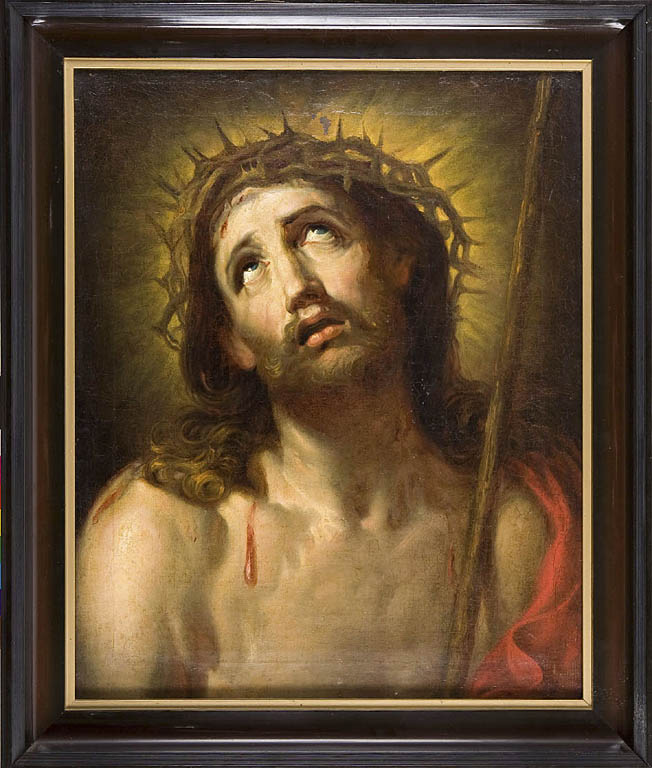
The auction record
The painting was offered at DESA Unicum in Warsaw on 16 April 2009 as lot 71. The catalogue used a deliberately cautious attribution — “Walenty Wańkowicz (?)” — and recorded the medium as oil on canvas, dimensions of 55.5 × 46 cm, and a handwritten inscription on the reverse reading “F. Walanty Wańkowicz”. Its present location has not been established in the published sources consulted by The Missing Canvas.
Wańkowicz and the Ecce Homo subject
Dalia Tarandaitė's 2002 study is particularly important because it shows that several distinct records of Christ images by Wańkowicz must be kept separate. She notes a Christ image painted in 1832 for Andrzej Towiański's unsuccessful approach to Sergei S. Stroganov, but the source does not identify its iconographic type. Separately, Wincenty Smokowski described an Ecce Homo by Wańkowicz and stated that the image was disseminated by lithography in St Petersburg and Lithuania; Tarandaitė does not give a present location for that original.
Tarandaitė also discusses a later Paris Ecce Homo made from an engraving after Guido Reni supplied by Towiański. She emphasises that it was not an exact copy: Wańkowicz used Reni's composition while introducing his own emotional understanding of Christ's suffering. Her catalogue note records that this Paris painting survives in the Adam Mickiewicz Museum of Literature in Warsaw and measures 92 × 71.5 cm; a related watercolour design for the Towiańskian banner also survives there. The 55.5 × 46 cm DESA canvas therefore cannot simply be identified with the surviving Paris work.
After Guido Reni — interpretation rather than mechanical copy
The auction painting follows the familiar Reni-derived devotional type: Christ is shown half-length, crowned with thorns, looking upward, with the reed at the right and a red mantle over the shoulder. For scholarly catalogue purposes, “after Guido Reni” or “based on Guido Reni” is preferable to “copy”. The wording acknowledges clear compositional dependence while leaving room for differences of handling, proportion, light and emotional emphasis.
An unresolved identification
The most interesting possibility is not that the DESA painting is the Paris Ecce Homo — the dimensions and documented survival of that work exclude a simple identification — but that the auction canvas could represent another Wańkowicz variant, perhaps related to the earlier Ecce Homo praised by Smokowski. At present there is not enough evidence to make that claim. Comparison with the nineteenth-century lithograph, technical examination, provenance before 2009 and study of the reverse inscription would be essential.
Sources
Dalia Tarandaitė, “Valentinas Vankavičius”, Lietuvos dailės muziejaus metraštis, 5 (2002), pp. 26–60; Zofia Ciechanowska, “Malarz Sprawy Walenty Wańkowicz”, Pamiętnik Literacki, 38 (1948), pp. 429–475; DESA Unicum, 160 Aukcja Dzieł Sztuki, 16 April 2009, lot 71.