

When writing about nineteenth-century art in Lithuania, it is easy to construct a history centred almost entirely on Vilnius: the university, its professors, the private drawing schools that followed, and the country estates whose owners commissioned portraits and landscapes from local artists. Yet the careers of the artists themselves reveal a considerably broader geographical world. St Petersburg was especially important as a place of academic training, while Rome, Dresden, Munich, Düsseldorf, Madrid and London repeatedly appear in artists’ biographies. Paris occupies a particular place within this network. It was never the sole destination, nor did it exercise the same influence on every artist, but throughout the century it recurred as a place of study, political exile, professional opportunity and, for some, permanent settlement.
The relationship between Vilnius and Paris therefore cannot be reduced to a simple story of provincial artists travelling toward a metropolitan centre. The routes were more complicated, and often more interesting. Some painters left Vilnius for Paris and continued almost immediately to Rome. Others reached France only after participating in political uprisings. Some returned to Lithuania carrying with them experience acquired abroad; others remained within émigré circles in Western Europe. By the later nineteenth century Paris also offered a publishing and graphic-art industry capable of providing artists with commissions that would have been impossible to obtain in Vilnius. The institutional starting point for much of this history was Vilnius University, whose departments of painting, drawing, sculpture and architecture produced what later came to be known as the Vilnius School of Art. The university was closed by the imperial authorities in 1832, bringing the institutional history of the school to an end, although its influence continued through former professors, private studios, the Vilnius Nobility Institute and successive generations of pupils.
Kanuty Rusiecki: from Vilnius to Paris and Rome
Kanuty Rusiecki, born in 1800, provides one of the earliest and clearest examples of this European mobility. He studied at Vilnius University between 1816 and 1821, where Jan Rustem and the sculptor Kazimierz Jelski were among his teachers. In 1821 he left for Paris and continued his studies at the Academy of Fine Arts, before moving to Rome the following year. His years in Italy would ultimately leave the more visible imprint on his work: Italian architecture, landscapes and scenes of everyday life occupy an important place in his surviving oeuvre, and his encounter with the artistic environment of Rome was more prolonged than his stay in France. Paris should therefore not be presented as the decisive centre of Rusiecki’s career, but neither should it be treated as an incidental stop. His journey demonstrates how naturally a young painter educated in Vilnius could already understand artistic training as something that extended beyond the city, through several European centres rather than toward one final destination.
Rusiecki returned to Vilnius in 1831, just as the institutional environment in which he had been educated was collapsing. From 1834 until his death in 1860 he taught drawing at the Vilnius Nobility Institute, thereby becoming one of the figures through whom the earlier university tradition was transmitted to a younger generation. This aspect of his career is particularly important because it complicates the familiar idea of talented artists simply leaving Lithuania for more important artistic centres abroad. In Rusiecki’s case, knowledge travelled outward and then returned. His experience of Paris and Rome became part of the education he subsequently offered in Vilnius, and through his pupils it continued to influence the artistic culture of the city long after the university had ceased to function.


Napoleon Iłłakowicz: Paris after political defeat
The route taken by Napoleon Iłłakowicz was shaped far more directly by political events. Born in 1811, he entered Vilnius University in 1830 and studied under Jan Rustem, but his academic life was interrupted almost immediately by the November Uprising. Iłłakowicz participated in the insurrection and, after its defeat, emigrated to France. From 1833 he continued his artistic education in Paris. In his biography, therefore, Paris appears not merely as a desirable artistic centre but as part of the geography of political exile that emerged after 1831. France, and Paris in particular, became one of the principal destinations for émigrés from the lands of the former Polish-Lithuanian Commonwealth, bringing artists into contact with writers, aristocrats, political activists and other displaced members of the same cultural world.
Iłłakowicz did not remain confined to Paris. He studied in Spain in 1836 and subsequently worked in France, Italy, Spain and other parts of Western Europe before eventually living in Lviv and returning to Vilnius in 1857. His landscapes preserve this geographical breadth. Titles such as Mill on the Seine, Landscape of Southern France and Devil’s Bridge in the Pyrenees show how directly his years abroad entered his work. By the time he returned to Vilnius, he had spent a substantial part of his adult life in Western Europe and had developed within an artistic environment very different from the one in which Rustem had first taught him. His career is a useful reminder that the history of Lithuanian nineteenth-century art becomes international almost immediately once one follows individual painters rather than institutions.
Walenty Wańkowicz and the émigré world of Paris
Walenty Wańkowicz reached Paris under different circumstances. One of the most accomplished portraitists associated with the Vilnius School, he had already established his artistic identity long before arriving in France. His best-known work, the portrait of Adam Mickiewicz leaning against the rock of Ayu-Dag, belongs to his St Petersburg period and became one of the most widely recognised images associated with Polish-Lithuanian Romanticism. Paris entered his biography only near the end of his life, but the circumstances of his arrival reveal another important aspect of the city’s significance for artists from the former Commonwealth.
Wańkowicz came to Paris in the autumn of 1841, following Andrzej Towiański, whose religious and mystical ideas had increasingly attracted him. There he again entered the orbit of Adam Mickiewicz and the émigré community surrounding the poet. Already weakened by illness, he died in Paris on 12 May 1842. The importance of Paris in Wańkowicz’s life should therefore not be exaggerated in artistic terms: it was neither the place where his style was formed nor the setting of a new mature phase. Its significance lies instead in the way the city gathered together people whose earlier relationships had been formed in Vilnius, Minsk, Novogrudok and St Petersburg. By the 1840s Paris had become one of the places where fragments of the intellectual and artistic world of the former Commonwealth were reconstructed in exile.

Tadeusz Gorecki: Paris as home
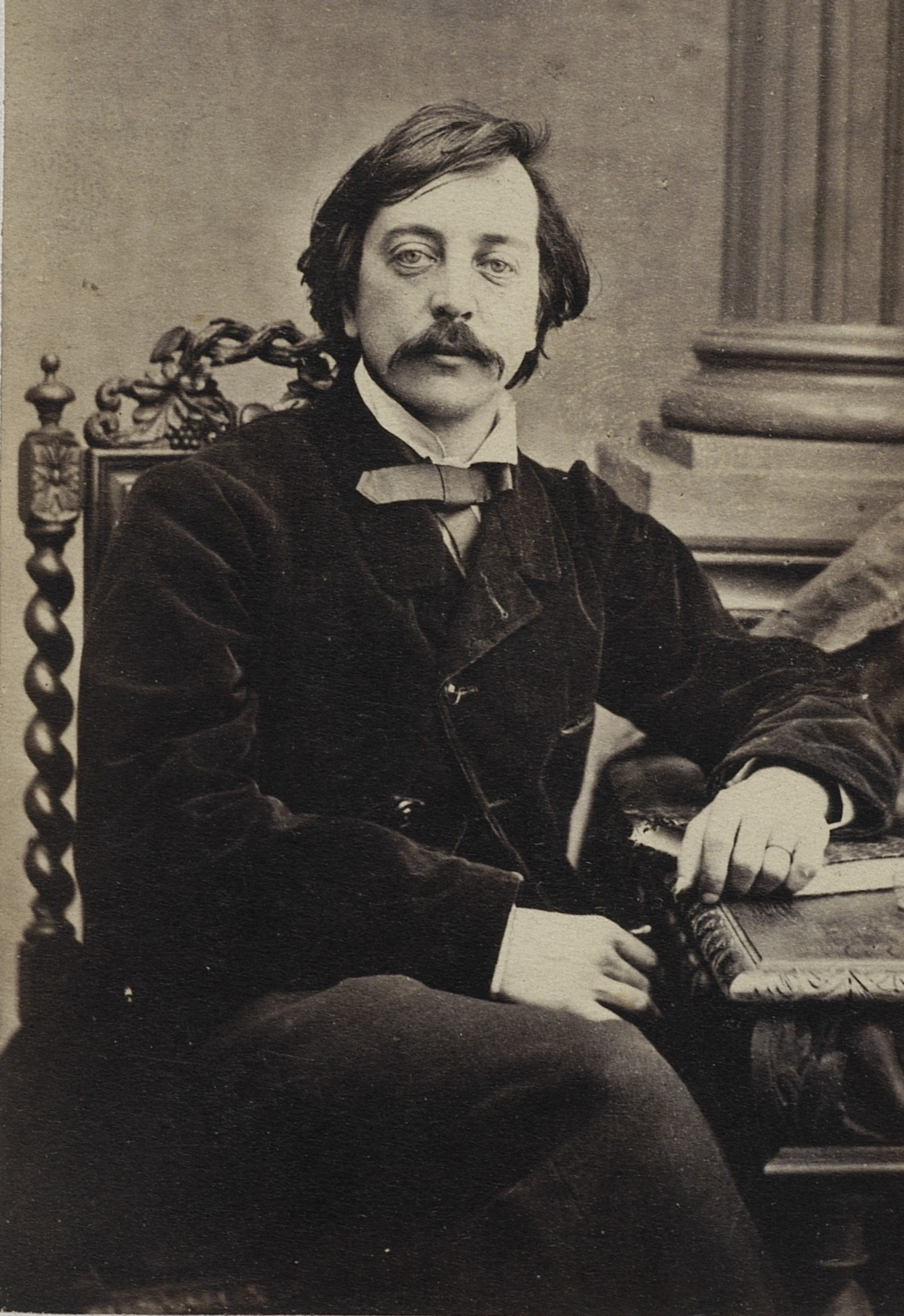
For Tadeusz Gorecki, the relationship with Paris was longer and more substantial. Born in 1825 at Dusinėnai near Vilnius, he received his earliest artistic instruction in Vilnius and studied in the painting school of Wincenty Dmochowski before entering the Imperial Academy of Arts in St Petersburg in 1841. There he studied under Karl Briullov and also participated in work connected with the decoration of St Isaac’s Cathedral. His education already placed him between several traditions: the artistic environment inherited from Vilnius, the formal discipline of the St Petersburg Academy and the broader European academic culture embodied by Briullov.
In 1849 Gorecki left for Paris to continue his artistic development, although France was only one stage in a wider period of travel. He subsequently visited Spain, where he copied old masters and painted views of the Alhambra, and also travelled in Italy. By 1854 he was again in St Petersburg, while the following year he was sent to Bologna to execute a copy of Raphael’s Saint Cecilia. Only in 1857 did Paris become something more permanent. Gorecki settled there, worked as a teacher of painting and drawing, produced portraits and religious compositions, and copied old masters in the Louvre. He remained in Paris until his death in 1868.
His private life also connected him closely to the émigré milieu, most notably through his marriage to Maria Mickiewicz, the daughter of Adam Mickiewicz. In Gorecki’s biography, Paris therefore represents both an artistic centre and a social world in which the culture of the former Polish-Lithuanian Commonwealth continued to exist outside its historical territory. His career cannot be adequately described as belonging to Vilnius, St Petersburg or Paris alone. Each city formed a different part of his artistic identity, and it is precisely this overlapping geography that makes his life characteristic of the period.
Alfred Römer and the continuation of the Vilnius tradition
Alfred Römer belonged to a younger generation. Born in Vilnius in 1832, the same year in which the university was closed, he could not have been educated within the institutional Vilnius School itself. Instead, he inherited its tradition indirectly. He first studied drawing with Wincenty Dmochowski and later, between 1845 and 1850, under Kanuty Rusiecki at the Vilnius Nobility Institute. The sequence is revealing: Rustem had taught Rusiecki, and Rusiecki, after studying in Paris and Rome and returning to Vilnius, became one of Römer’s teachers. What disappeared institutionally in 1832 continued through personal transmission.
Römer’s subsequent career was thoroughly European. In 1857 he travelled with Jan Zienkiewicz through Dresden, Berlin, Cologne, Brussels, Bruges and Switzerland and maintained studios at different moments in Paris, Rome and Ostend. His involvement in preparations for the January Uprising led to arrest, imprisonment and the sequestration of his estate, after which travel again became part of his life. Between 1867 and 1874 he lived in France, Switzerland, Bohemia and Germany; from 1869 to 1871 he studied painting and graphic art in Paris before continuing his education at the Munich Academy, where portraiture became an increasingly important part of his work.
What makes Römer especially interesting is that long periods abroad did not weaken his engagement with Lithuania. He collected ethnographic material, studied local monuments and artistic heritage, wrote about Vilnius churches and the Vilnius School, and gathered biographical information about earlier artists. His life therefore challenges the assumption that international training necessarily led artists away from local historical concerns. In Römer’s case, European experience existed alongside an increasingly deliberate attempt to understand and document the culture from which he had come.


Józef Marszewski and the European landscape circuit
Józef Marszewski offers a somewhat different model because his career developed primarily through landscape painting and because Paris formed only one part of a much broader European itinerary. His early biography is not documented with the same precision as those of some of his contemporaries, although Lithuanian scholarship associates him closely with Vilnius and records possible early study under Wincenty Dmochowski before his education at the Imperial Academy in St Petersburg between 1853 and 1856. What is certain is that after his academic studies he travelled extensively and absorbed several different landscape traditions.
From 1857 onward Marszewski moved through a number of European centres. Paris appears repeatedly in his travels, but so do Spain, Switzerland, Rome and Düsseldorf, where he studied under Andreas Achenbach. His subject matter similarly reflects a wide geography, ranging from Lithuania and Vilnius to Italy, Germany, Switzerland, Ukraine and the mountain regions of Central Europe. Marszewski’s biography is useful precisely because it prevents Paris from becoming too dominant in the narrative. For many nineteenth-century artists there was no single artistic capital. Düsseldorf could be more important for landscape painting, Rome for the study of the old masters and classical art, St Petersburg for official academic recognition, and Paris for exhibitions, collections, professional contacts or simply another stage in a long period of travel. The artistic world through which these painters moved functioned as a network rather than a hierarchy with one inevitable centre.
Albert Żamett and the limits of the evidence
Albert Wojciech Żamett belongs naturally within the same discussion of mobility, although his connection with Paris should be treated more cautiously. Born in Vilnius in 1821, he studied under Kanuty Rusiecki at the Vilnius Nobility Institute and later at the Imperial Academy in St Petersburg. Between 1847 and 1858 he travelled and continued his education abroad, spending time in Italy, France, Germany and Britain and attending the Accademia di San Luca in Rome. He eventually returned to Vilnius and became closely involved in the city’s artistic and cultural life, working as a landscape painter and theatre decorator and maintaining links with the Museum of Antiquities.
The surviving evidence establishes France as part of Żamett’s European travels, but it does not justify presenting Paris as a major documented chapter of his career in the same way as it can be for Gorecki, Römer or Andriolli. That distinction is important. Nineteenth-century artist biographies are often reconstructed from uneven archival material, and there is a temptation to turn every journey through France into a significant Parisian episode simply because the city fits an attractive narrative. A more careful reading allows uncertainty to remain where the evidence is incomplete. Żamett is relevant here not because Paris necessarily transformed him, but because his career demonstrates the same broader structure: artistic beginnings in Vilnius, further training in St Petersburg, years of study and travel through Western Europe, followed by a return to active cultural life in Vilnius.
Michał Elwiro Andriolli: Paris as exile and professional market
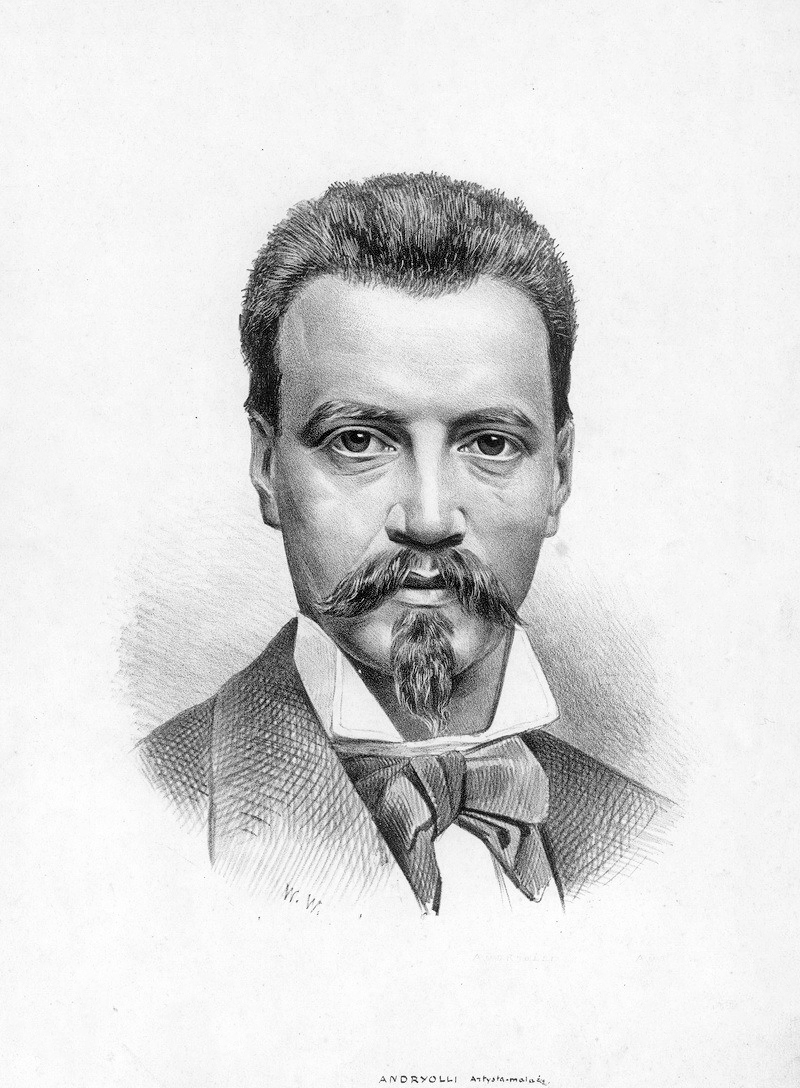
Michał Elwiro Andriolli represents perhaps the most dramatic combination of politics and professional opportunity. Born in Vilnius in 1836, he studied in Moscow, at the Imperial Academy in St Petersburg and later in Rome. His participation in the January Uprising of 1863 fundamentally altered the course of his life. After the defeat of the uprising he escaped through Riga and London to Paris, where he entered Polish émigré circles and renewed contact with Władysław Mickiewicz, the son of Adam Mickiewicz. He also began working with the French illustrated press, including L’Illustration.
By the second half of the nineteenth century Paris offered artists possibilities that went well beyond academic study. The rapid expansion of illustrated books, newspapers and periodicals had created a substantial professional market for draughtsmen and illustrators. An artist could establish a reputation not only through easel painting or the Salon but through publishing houses, engravers and illustrated journals whose products circulated internationally. Andriolli was exceptionally well suited to this world. His abilities as a draughtsman eventually made illustration central to his career, although his first period in Paris was interrupted by his attempt to return east, his arrest and subsequent exile in Vyatka.
Paris returned to his life in the 1880s. In 1883 Andriolli went back to the city and established connections with French publishers, receiving substantial commissions at a time when illustrated literature was flourishing. During this period he also produced a major Pan Tadeusz composition for Count Benedykt Henryk Tyszkiewicz. The circumstances are characteristic of the cultural complexity of the period: a Vilnius-born artist, displaced in part by the politics of the January Uprising, was working professionally in Paris while illustrating a literary work whose imaginative geography was rooted in the historic lands of Lithuania.
A history shaped by movement
Taken together, these careers do not form a coherent Lithuanian colony in Paris, nor would it be useful to invent one retrospectively. The artists differed too greatly in generation, training, political circumstances and artistic aims. Rusiecki passed through Paris as a young student on his way toward a longer Italian period; Iłłakowicz arrived after the defeat of the November Uprising and continued his training there as a political émigré; Wańkowicz spent the last months of his life within the Parisian émigré circle surrounding Mickiewicz; Gorecki first arrived as part of a wider European education and later made the city his permanent home; Römer returned to Paris during several stages of an unusually mobile career, while Marszewski encountered it as one of several centres important to a travelling landscape painter. Andriolli found there first refuge and later a professional publishing market.
What these lives share is not a common Parisian style but a broader historical condition. The artistic culture that emerged from nineteenth-century Vilnius was never isolated from Europe, and after the closure of the university in 1832 its dependence on personal networks and external centres of training became even more pronounced. Former professors continued to teach, private workshops survived and the Vilnius Nobility Institute maintained drawing instruction, yet for artists seeking advanced academic training, contact with major collections, exposure to new artistic tendencies or access to a larger professional market, movement remained essential.
This movement also has consequences for the way nineteenth-century Lithuanian art is encountered today. Paintings followed artists abroad, entered the collections of patrons and friends, passed through marriages and inheritances, and sometimes remained in the countries where they had been made. Portraits could remain with émigré families for generations, while landscapes painted in France, Italy, Spain or Switzerland entered local collections whose later owners may have known little about the artist’s connection with Vilnius. A work that appears far from Lithuania today is therefore not necessarily detached from its historical context; sometimes its location is itself evidence of the artist’s biography.
For collectors and researchers this makes provenance especially important. A painting by Iłłakowicz emerging from a French collection, a work by Gorecki preserved within an émigré family, an Andriolli drawing carrying evidence of a Parisian publisher or a Marszewski landscape found in Western Europe would all fit naturally within the documented movements of these artists. Their biographies offer more than narrative background: they can provide practical clues to where works travelled, who might have owned them and why they remained abroad.
The phrase “Vilnius School” inevitably draws attention toward one city, and rightly so, because the university and the extraordinary network of teachers and pupils assembled there at the beginning of the nineteenth century were fundamental to the development of professional art in Lithuania. Yet the history that followed cannot be contained within Vilnius. Its artists travelled, their students travelled, political uprisings dispersed them further, and their works often followed routes independent of the places where they had first been painted. Paris was one important point within this wider geography, sometimes a school, sometimes a refuge, sometimes a market and, in a few cases, a home.
Seen from this perspective, nineteenth-century Lithuanian art appears considerably less provincial than later national boundaries might suggest. The artists associated with Vilnius were not working at the edge of Europe and merely observing its principal centres from a distance. They studied in those centres, lived in them, worked for their patrons and publishers, absorbed their collections and artistic debates, and carried elements of that experience elsewhere. At the same time, many continued to paint Lithuanian subjects, maintain family connections with the region or participate in its cultural memory long after they had left. There was therefore no single road from Vilnius to Paris, but numerous journeys undertaken for different reasons and at different moments of the century. Together they reveal an artistic world defined as much by movement as by place, and the paintings moved as well, sometimes remaining abroad long after the circumstances that had carried their makers there had been forgotten. For anyone attempting to reconstruct the history of these artists today, that movement is not a secondary detail; it is part of the history itself.
Private acquisition & research
Works connected with the nineteenth-century Vilnius tradition
The Missing Canvas is interested in paintings, drawings and archival material by artists discussed in this essay, particularly works that have remained in private or family collections outside Lithuania. Old labels, inscriptions, photographs and family provenance can be especially important when reconstructing how a work travelled.
Owners, descendants, advisers and dealers are invited to contact Dominykas Šaudys, Art Dealer & Collector, confidentially. Contact The Missing Canvas.
Selected references
- Visuotinė lietuvių enciklopedija, “Vilniaus meno mokykla”.
- Visuotinė lietuvių enciklopedija, “Kanutas Ruseckas”.
- Visuotinė lietuvių enciklopedija, “Napoleonas Ylakavičius”.
- Culture.pl, Walenty Wańkowicz and the portrait of Adam Mickiewicz.
- Visuotinė lietuvių enciklopedija, “Tadas Goreckis”.
- Visuotinė lietuvių enciklopedija, “Alfredas Römeris”.
- Lithuanian Art Fund, Józef Marszewski.
- Visuotinė lietuvių enciklopedija, “Albertas Vaitiekus Žametas”.
- Culture.pl, Michał Elwiro Andriolli.
Comments & research notes
Share a provenance lead
If you know of a painting, archive, family collection or Paris provenance connected with one of these artists, you are welcome to contribute a research note.
Loading comments…